 RSS Feed
 Twitter
 Facebook
 Email
Email Home
HomeCash Strapped Seniors Beware!!
Posted by Larry Doyle on October 6th, 2009 2:53 PM |
Tapping home equity was a prime driver in leading us into our current economic crisis. The same dynamic with an added twist may very well be setting the table for another round of fraud and accompanying problems.
I refer to the housing finance product known as a reverse mortgage. This product is targeted primarily at our senior citizens who are cash strapped. Rest assured many a mortgage banker who is currently hard pressed to generate fees and earnings will attempt to take Grandma and Grandpa ‘to the hoop’ with this product.
While many quality professionals within the mortgage industry will work to highlight the potential pitfalls with reverse mortgages, do not think for a second that those messages will make their way to every customer.
Bloomberg highlights that our legal profession is starting to take notice of this ‘racket’ and writes, Reverse Mortgages May Be ‘Subprime Revisited’:
Reverse mortgages may be the next subprime crisis, according to the National Consumer Law Center.
Some of the same U.S. lenders that helped drive the real estate boom with loans to home buyers who couldn’t afford the payments are now targeting seniors, the center said. Brokers, who are given financial incentives to sell the loans, may be making misleading claims to potential customers, according to a report released today by the Boston-based NCLC.
“This market is designed to serve seniors, so when we find abuses cropping up and migrating from the subprime market to the senior market, that sounds an especially loud warning bell,” said Rick Jurgens, an advocate at the National Consumer Law Center, who contributed to the report.
Reverse mortgages enable people aged 62 and over who are looking for extra cash to use the equity in their homes and receive lump-sum payments, periodic checks, a line of credit, or a combination of the three. Lenders are repaid from the sale of the home when the borrowers die or move.
The former maximum payout for reverse mortgages backed by the Federal Housing Administration was $417,000. That limit was increased temporarily to $625,500 in February. Origination fees are capped at $6,000. In 2008, more than 100,000 seniors used reverse mortgages to tap over $17 billion in home equity, according to the Housing and Urban Development Department.
I implore anybody who reads this commentary to fully explore the implied mortgage rate and home appraisal values utilized with reverse mortgages.
Any questions, please do not hesitate to ask or to utilize the mortgage primers (in the left sidebar) here at Sense on Cents to learn more about this product.
LD
Increasing Vacancy Rates Will Pressure Both the Rental Market and Home Values
Posted by Larry Doyle on October 6th, 2009 11:42 AM |
You do not need to take Economics 101 to understand that an increase in supply of any asset will almost always lead to a decline in prices. This ‘tremendous grasp of the obvious’ in regard to housing runs right in the face of assertions put forth by many real estate brokers and housing experts.
High five to our friends at 12th Street Capital for bringing attention to The Wall Street Journal‘s writing, Apartment Glut Expands:
Signs advertise apartments for rent in San Francisco in July. Rents declined during the third quarter, usually a strong period for rentals. (Getty Images)
Apartment vacancies hit their highest point since 1986, surging in cities from Raleigh, N.C., to Tacoma, Wash., as rising unemployment continued to chip away at demand during the traditionally strong summer rental months.
The U.S. vacancy rate reached 7.8%, a 23-year high, according to Reis Inc., a New York real-estate research firm that tracks vacancies and rents in the top 79 U.S. markets. The rate is expected to climb further in the fall and winter, when rental demand is weaker, pushing vacancies to the highest levels since Reis began its count in 1980.
(more…)

Wall Street Compensation Reform in Name Only
Posted by Larry Doyle on October 6th, 2009 9:27 AM |
 Say what you want about movie producer Michael Moore, but he is no fool in tapping into the American spirit. Moore takes on Wall Street in highlighting the enormous bank bailouts emanating from this economic crisis. While there are many factors that drove our banking industry and our economy to its knees, ultimately the Wall Street compensation system allowed those taking risk to ‘swing for the fences’ while playing ‘heads we win, tails you lose.’ Washington is going to fix this, right? Having appointed a pay czar in Ken Feinberg, the Obama administration is going to address the crux of this critical issue and reform it, right? I mean, The Wall Street Journal this very morning profiles how Pay Czar Targets Salary Cuts:
The Obama administration’s pay czar is planning to clamp down on compensation at firms receiving large sums of government aid by cutting annual cash salaries for many of the top employees under his authority, according to people familiar with the matter.
Instead of awarding large cash salaries, Kenneth Feinberg is planning to shift a chunk of an employee’s annual salary into stock that cannot be accessed for several years, these people said. Such a move, the most intrusive yet into corporate compensation, would mark the government’s first effort to curb the take-home pay of everyone from auto executives to financial traders.
Folks, with all due respect to Ken Feinberg, these efforts to implement reform in Wall Street compensation practices are largely a joke. Why? While the subtitle of the WSJ’s article includes the term ‘compensation,’ Feinberg’s focus is limited to the term in the title, that being ‘salary.’ (more…)
“Cash for Clunkers” Final Grade: F
Posted by Larry Doyle on October 5th, 2009 3:31 PM |
 How did that “Cash for Clunkers” program ultimately grade out? While auto dealers were relishing the traffic that overwhelmed their showrooms, the fact is the program was nothing short of a government redistribution charade masked as an economic stimulus. If this type of program is the best we can do, we are in worse shape politically and economically than I thought.
While some pundits would sing the praises of the “Cash for Clunkers” program, fundamentally I have a difficult time understanding how real value is created when current value is destroyed in the process. Additionally, there was never a doubt that this program was merely pulling demand forward. How do we know this?
U.S. auto sales declined 23% for the month of September on a year over year basis. Sales for GM (-45%) and Chrysler (-42%) vehicles declined precipitously while Ford (-5%) declined only marginally. What does that indicate? Car buyers want to purchase a vehicle in which they have confidence in the manufacturer.
The Wall Street Journal sheds further light on this ‘clunker’ in writing, Clunkers In Practice:
Cash for clunkers had two objectives: help the environment by increasing fuel efficiency, and boost car sales to help Detroit and the economy. It achieved neither. According to Hudson Institute economist Irwin Stelzer, at best “the reduction in gasoline consumption will cut our oil consumption by 0.2 percent per year, or less than a single day’s gasoline use.” Burton Abrams and George Parsons of the University of Delaware added up the total benefits from reduced gas consumption, environmental improvements and the benefit to car buyers and companies, minus the overall cost of cash for clunkers, and found a net cost of roughly $2,000 per vehicle. Rather than stimulating the economy, the program made the nation as a whole $1.4 billion poorer.
The basic fallacy of cash for clunkers is that you can somehow create wealth by destroying existing assets that are still productive, in this case cars that still work. Under the program, auto dealers were required to destroy the car engines of trade-ins with a sodium silicate solution, then smash them and send them to the junk yard. As the journalist Henry Hazlitt wrote in his classic, “Economics in One Lesson,” you can’t raise living standards by breaking windows so some people can get jobs repairing them.
In the category of all-time dumb ideas, cash for clunkers rivals the New Deal brainstorm to slaughter pigs to raise pork prices. The people who really belong in the junk yard are the wizards in Washington who peddled this economic malarkey.
I concur. What do you think?
LD
Financial Literacy Is the First Step to Financial Independence
Posted by Larry Doyle on July 22nd, 2009 3:12 PM |
Financial literacy does not guarantee financial independence but it is a necessary first step.
In a society which has undervalued thrift and prudent financial management, is it any wonder our country is woefully unprepared to help future generations become financially literate?
The goal of Sense on Cents is to help people navigate the economic landscape, from whatever point of departure on that landscape they may currently occupy.
The Medill Washington Program recently reported on challenges to improve financial literacy. From the article Financial Literacy Programs Face Uphill Climb:
“The economic crisis was caused by the fact that a lot of Americans lack basic financial literacy skills, which makes it difficult to make wise credit decisions, as was evidenced by the mortgage crisis and other areas of the overall economic crisis,” said Levine. “However, with the advent of the new presidency, also comes a new approach when it comes to undertaking the goal of increasing national financial literacy in schools. And the transition to this new approach takes time.”
Everett Hoffman, 22, of Staten Island, N.Y., wishes he had taken the elective of a personal financial education course in high school. He thinks it would have helped him make wiser spending choices.
“I think it might have been good because I’m learning a lot of things the hard way now being a young adult,” said Hoffman. “But I really do think taking that class might have helped me avoid some minor debit card issues I’ve been having lately, you know basics, like balancing a checkbook.”
Allison Joseph, 21, of Chesapeake, Va., also interviewed on the National Mall, said that her parents still shelter her from having to take care of her finances. She took a macroeconomics course in high school that did not cover personal finance.
“When I went to college, I started getting my own credit card statements, but my parents have always helped me out, so I’m not totally independent in that sense.”
Up to now, only three states require at least a one-semester course devoted to personal finance – Utah, Missouri and Tennessee. Eighteen other states require personal finance instruction to be incorporated into other subject matter. The rest have no requirements, but leave individual schools the choice to implement personal finance education programs in their curricula.
According to JumpStart, a personal financial education course would give students a head start at being less debt-prone by teaching them how to manage checkbooks, how mortgages work, and other basic financial life skills.
I will readily admit that the tone and tenor of my writing at Sense on Cents is not geared toward high school students, but certainly the Financial Primers in the right sidebar (Debt Management, Financial Aid, Insurance, Investing, Mortgage Finance) provide a wealth of information for anybody embarking down a financial path.
By the same token, I am heartened by the number of college students and recent college grads who have informed me how much they have learned and are learning from Sense on Cents.
Please spread the word and do not be bashful about asking me anything.
Financial literacy is the first step in becoming financially educated which is the path to becoming financially independent.
I am happy to help you navigate along the way.
LD
Surf’s Up at Sense on Cents
Posted by Larry Doyle on July 19th, 2009 2:35 PM |
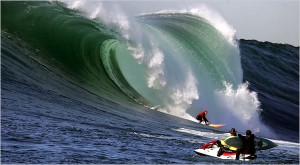 (bumped up from Saturday afternoon)
For those cruisin’ this Saturday, the word is out that the Surf’s Up here at Sense on Cents. In lieu of our regular weekend respite with Recommended Reading, please allow me the opportunity to ride some waves with you.
The waves rollin’ across our shoreline include:
1. Career Planning : 25 years worth of resources, materials, and instincts to help those looking for a career in business.
2. Market Data: as close to a real-time link as you’ll find on the internet for market data across every sector of the market. Keep your brokers and financial planners honest!!
3. Newsworthy: There’s a little bit of everything here. Some stories have made headlines, others are off the beaten path. I regard them as newsworthy and hope they help you to stay ahead of the curve.
4. NoQuarter Radio: join me every Sunday evening for a live radio show providing truth and transparency as we navigate the economic landscape. All shows are taped and archived. You can listen to audio recordings of past shows right here on the Sense on Cents website, or download as a podcast from iTunes. From the iTunes application, just type in No Quarter Radio podcast in the search window of the iTunes store. All podcasts are a free subscription.
5. Reading Room: books providing market insights, perspectives on business and life, or some special inspiration. These books have made a profound impact on me during my time on and off Wall Street. All strongly recommended!
6. Financial Primers: in our right sidebar, these primers on Debt Management, Financial Aid, Insurance, Investing, and Mortgage Finance will hopefully help anybody and everybody get further up these respective learning curves. Additionally, I provide links to the debacles unfolding in Washington and state capitals via Subsidyscope and PensionWatch.
7. Economic All-Stars: in our left sidebar, access links to some of my favorite money mangers, economists, and regulators, including Tom Atteberry of First Pacific, Sheila Bair of the FDIC, Laszlo Birinyi, Bill Gross of PIMCO, Jeff Gundlach of TCW, Greg Mankiw of Harvard University, John Mauldin, Carmen Reinhart of the University of Maryland, Bob Rodriguez of First Pacific Advisors, Nouriel Roubini, and a whole host of Thought Leaders (leading economists) at Project Syndicate.
8. Archives: in our left sidebar, I have material from upwards of 600 uniquely written and thought provoking posts. The bulk of this material was written during the last 5 months. Whatever topic you’re looking for, just type it in the search window in the upper right hand corner of any page here at Sense on Cents, and you’ll most likely find it. Do not hesitate to ask for help or assistance, via a comment, if you need it.
In surfing the net over the last year, I have yet to find a financial ‘beachsite’ with this kind of talent and views. Please invite your friends!!
Rest assured, after the waves cresting over these links quiet at day’s end, there is still plenty of good banter and friendship provided by your host.
Enjoy and let’s have some fun while we collectively navigate the economic landscape!!
LD
Front End Springs a Leak
Posted by Larry Doyle on June 5th, 2009 4:57 PM |
In a manner of speaking, the management of our economy has been nothing short of a major overhaul of a tired old ship. When the tide went out, the base of our ship was exposed as being filled with holes.
Little did we know at the time, but through many of those holes a number of “pirates” were running off with a whole lot of booty. In the process, many market participants riding along on the main deck were thrown overboard by the economic storm that hit our economy and markets over the last two years.
We do not have the luxury of bringing our ship into port for an overhaul. We have had to continue to sail this ship while trying to repair it. In that spirit, by necessity we have had to add significant ballast (liquidity) in our hull. In so doing, we need to recognize that the ballast can itself be inflammatory if the engine generates a spark.
In purely economic terms, this morning’s non-farm payroll number of -345k jobs was a hint of a spark. While various sectors of the market gyrated today, the front end of our ship, that is the front end of our yield curve, sprung a serious leak. How so? Interest rates on short term Treasury notes increased a DRAMATIC 35 basis points. Why?
Traders are already pricing in an expectation that the Federal Reserve will be forced to increase the Fed Funds rate prior to any hint of inflation or even the expectation of inflation gains a foothold. Bloomberg sheds color on this likelihood, Traders Begin to Speculate Fed Will Need to Tighten:
Traders are beginning to price in expectations the Federal Reserve will raise interest rates this year as the recession shows signs of abating.
Federal-funds futures contracts on the Chicago Board of Trade show a 70 percent probability the central bank will lift its target rate for overnight bank borrowing to at least 0.5 percent by November after a report today showed the U.S. economy shed the fewest jobs in May in eight months. Rate-increase odds were 27 percent yesterday.
The Fed cut the target rate to the record low range of zero to 0.25 percent in December as the economy lapsed into the worst recession in decades. President Barack Obama and Fed Chairman Ben S. Bernanke have committed $12.8 trillion to thaw frozen credit markets and ramped up government spending to revive growth. The Fed last raised borrowing costs in June 2006, when policy makers pushed the rate to 5.25 percent.
Fed governors and Fed chair Bernanke now face a serious quandary. Economic data will remain decidedly weak. Unemployment will continue to increase. Consumers are going to remain strapped. Corporations will face challenges. Municipalities will encounter an ongoing decline in tax revenues. Nobody is going to truly feel like the economy is improving to the point that the Fed should even think about increasing interest rates. Then why is the market starting to price that reality into the market? Let’s go back into the hull.
The bowels of our ship are flush with liquidity and given any sort of traction in the economy, the velocity and growth in the money supply will drive inflation.
What is Big Ben and team to do? The market is raising interest rates on him rather than his raising interest rates on the market. In the process, a very fragile economy will now be forced to deal with higher interest costs along with anemic growth.
What do I see on our economic horizon? In my opinion, today’s price action took us in the direction of the island known as Stagflation.
Please share your thoughts and comments.
LD
Economic Update: Jobless Claims and Producer Prices
Posted by Larry Doyle on May 14th, 2009 10:42 AM |
Economic data released this morning included Initial Jobless Claims and Producer Price Index. Let’s dive right in!!
Initial Jobless Claims rose to 637k from last week’s reading of 601k, which was revised to 605k. The expectations for this week’s claims figure was 611k so the reading is disappointing as far as looking for stabilization within labor.
I am not surprised, though, for a few reasons:
1. we know there are going to be layoffs coming in the automotive industry. In fact, a large percentage of the increased unemployment filings came from states with heavy automotive exposure, especially Illinois.
2. as I reported in last Friday’s May Unemployment Report:
The fact that temporary government workers are factored into overall employment, in my opinion, is stretching the integrity of the report.
Thus, I am not surprised to see this week’s claims report higher than expected and I expect subsequent revisions to show higher claims as well.
In regard to the Producer Price Index, it was reported as an increase of .3% and without the volatile food and energy components as an increase of a mere .1%. No big deal, right? Well, it’s no big deal as long as you don’t eat. For those of us who actually look to consume food on a regular basis, this report is very troubling. Why?
Prices of food products rose 1.5%!! Including a rise of 43.7% for eggs, 5.2% for vegetables, 4.5% for beef, and 2.5% for pork.
Sense on Cents did receive very interesting color the other day about the state of produce in California. A reader shared:
The cost of food is on the rise faster than you can eat.
Now the feds have cut off water to the central valley and fields are not being farmed. I do not about you but ya might want to watch the price of a head of lettuce in NYC go through the roof.
Additionally, I was surprised to see a rise in prices for cars of .2% and light trucks of 1.1%. Despite the fact that car and truck sales are at depressed levels, the auto companies are in such desperate straits that they need to squeeze revenue wherever possible. That said, the asking prices of these vehicles may have risen, but who pays asking?
Please share insights on these fronts or any others from your local economies so we all can more effectively navigate the economic landscape!!
LD
Goldilocks Economy
Posted by Larry Doyle on May 8th, 2009 1:15 PM |
Will the wizards in Washington be able to recreate the Goldilocks economy, in which we can generate moderate growth with limited inflation and near full employment? Well, that economic dream is still off in the distance, but the Goldilocks analogy is appropriate. How’s that? Much like the cherished tale, the wizards are faced with three choices in virtually every situation: too much, too little, just right.
Fiscal policy
– too much spending and/or improperly targeted spending will drive interest rates higher via massive deficits and potential hyperinflation.
– too little spending and/or improperly targeted will not properly stimulate the economy and may lead to a bout of deflation.
– just the right amount of spending and properly targeted will support the economy and stabilize prices.
Monetary Policy
– too much gas on this fire will massively grow the money supply and lead to hyperinflation.
– not enough gas or a slow delivery (the concern in Europe) will not stop the economy from sliding into a deeper recession.
– just right will lead to support for the economy. However, our wizards must be prescient and know exactly when to turn the gas line down and then off. If this procedure is not executed with precision, our house may go up in the flames of hyperinflation. Many wise and elderly wizards, including none other than Paul Volcker, have this concern.
Regulatory
– overly restrictive regulations will inhibit an entrepreneurial spirit and drive business overseas.
– ineffective, inappropriate, or insufficient regulations will lead to further moral hazards and an economic foundation akin to a pile of sand. Dare I say, our house is suffering from this problem currently.
– just right would compel new regulators with real teeth to redraft the rules by which we play. Paul Krugman wrote “Stressing The Positive” in yesterday’s New York Time and addressed this topic. Krugman offers:
. . . what worries me most about the way policy is going isn’t any of these things. It’s my sense that the prospects for fundamental financial reform are fading.
Does anyone remember the case of H. Rodgin Cohen, a prominent New York lawyer whom The Times has described as a “Wall Street éminence grise”? He briefly made the news in March when he reportedly withdrew his name after being considered a top pick for deputy Treasury secretary.
Well, earlier this week, Mr. Cohen told an audience that the future of Wall Street won’t be very different from its recent past, declaring, “I am far from convinced there was something inherently wrong with the system.” Hey, that little thing about causing the worst global slump since the Great Depression? Never mind.
Those are frightening words. They suggest that while the Federal Reserve and the Obama administration continue to insist that they’re committed to tighter financial regulation and greater oversight, Wall Street insiders are taking the mildness of bank policy so far as a sign that they’ll soon be able to go back to playing the same games as before.
Uncle Sam’s intervention
– too much involvement means private enterprise will either not play in our markets or charge a higher price in the form of higher interest rates (this is VERY likely to happen given the disregard for property rights and the validity of contracts).
– too little and the economy may take another leg down in the form of a triple dip.
– just right . . . how do we compel Uncle Sam to be a benevolent Old Man and not encroach on the principles of capitalism, free markets, and private enterprise as he tries to push forward with a massive social agenda and enormous spending plans?
The trail on which we are proceeding will be LONG. Will we be able to find that warm home in the woods? Do we have the fortitude and courage to sacrifice as need be or do we have leaders who are blinded by ambition and agendas which will cause us to lose our way?
Bring extra supplies.
LD
NoQuarter Radio’s Sense on Cents with Larry Doyle Tonight at 8PM
Posted by Larry Doyle on May 3rd, 2009 7:38 AM |
UPDATE: The show has concluded, but you can listen to a recording of it in its entirety by clicking the Play button on the audio player below. Once the playback has started, you can fast forward or rewind to any portion of the show by clicking at any point along the play bar. Topics this evening included: the Chrysler bankruptcy situation, Bank Stress Tests, and Auction Rate Securities.

******************************
Please join me Sunday evening from 8-9 p.m. ET for NoQuarter Radio’s Sense on Cents with Larry Doyle. The developments in the markets, economy, global finance, Wall Street, and Washington are occurring at breakneck speed.  I will try to slow things down a bit and provide a sense of perspective. What did we learn in the markets over the last week and what does that mean for the weeks and months ahead? We will address a wide range of issues, including: the auto industry, government bond market, and economic statistics.
These are truly historic times in the global economy. Let’s “navigate the economic landscape” without the pandering or nonsense found elsewhere! What is on your mind? What would you like to address? Please share your questions and thoughts by calling in to (347) 677-0792, and also join our live chat room, which I’ll start up about 10 minutes before the show begins.
Many thanks to Larry Johnson and the rest of the team at NoQuarterUSA blog for providing such a vibrant vehicle as NoQuarter Radio. I look forward to having you join me Sunday evening as we collectively navigate the economic landscape!!
LD


