Subscribe: RSS Feed | Twitter | Facebook | Email
Home | Contact Us

Tea Is Served

Posted by Larry Doyle on April 4th, 2009 4:45 PM |

I strongly believe Congress and the Obama administration know that the American public has no appetite for further government bailouts. This public demeanor presents a challenge for a government that has gotten used to writing big checks for Wall Street, the Stimulus, and automotive companies. 

What is the federal government to do for municipalities, insurance companies, commercial real estate companies, or others who may go bankrupt?

Secretary Geithner has laid the groundwork for government takeover of institutions deemed to present systemic risk. How that power is effected or implemented will be very interesting. Read the rest »


Remaining on Guard…

Posted by Larry Doyle on April 4th, 2009 10:07 AM |

I much prefer a rallying stock market, but I am not a day trader trying to catch moves for quick flips. I look for changes in economic fundamentals (incorporating both private sector and public sector inputs), assess those changes with market technicals (overbought and oversold conditions), and position myself accordingly.

The big wild card in current analysis is the impact of public sector inputs. Many of the maneuvers utilized by the Treasury and Federal Reserve have never been used prior to this economic downturn. Are they working? To what extent? What are the unintended consequences? What is the time delay from implementing a program to measuring its impact on the economy? These questions are the topics of protracted discussions by economists, bankers, analysts, and money managers around the globe. I’d also like to address them here at Sense on Cents.

My market instincts tell me that programs injecting trillions of dollars across wide swaths of the market are not without costs. These costs in the form of “crowding out“, distorted competition, changed behaviors (AIG undercutting insurance rates), moral hazards, and inflation are very real. The challenge is assessing the risks of these long term costs versus the necessity of providing sufficient capital and liquidity backstops to support the economy.  Read the rest »


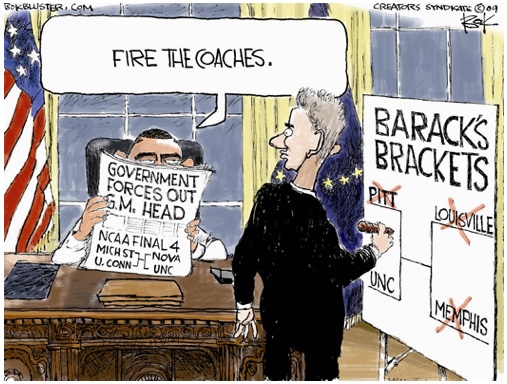
Knocked Out of the Final Four

Posted by Larry Doyle on April 3rd, 2009 8:40 PM |

ncaa-cartoon1

Cartoon by Chip Bok


Talk May Be Cheap But It’s Expensive!!

Posted by Larry Doyle on April 3rd, 2009 5:59 PM |

Who says money does not talk…and I guess, by the same token talk may be cheap but it’s expensive. 

The WSJ reports, Summers Received Over $5 Million From D.E. Shaw.

Right in line with my March 9th piece, How Wall Street Bought Washington.

LD


Afternoon Market Update April 3rd

Posted by Larry Doyle on April 3rd, 2009 4:01 PM |

On the heels of the G-20 and the April Unemployment Report, there are some interesting crosscurrents playing out in the market. The price action strikes me as inconsistent. Given some of these inconsistencies, I believe the price action actually reflects the squaring of positions of many short term traders who are being tested.

Equities: despite an Unemployment Report that is in line with expectations, this report was weaker than expectations. That weakness is reflected in the revisions to January’s report and the decline in the hourly workweek. Despite the ongoing economic weakness, stocks are slightly higher on the day and are closing out the 4th strong week in a row.

Bonds: typically economic weakness would indicate a decline in interest rates and a move higher in bonds. Market activity is reflecting the exact opposite. 10 year U.S. government bonds are significantly lower in price with the rate on these bonds back up to 2.90%, which is higher by 12 basis points on the day. Read the rest »


32 Bid/84 Ask

Posted by Larry Doyle on April 3rd, 2009 11:14 AM |

Will banks sell toxic assets? This question is being asked ad nauseum. Investors have indicated a willingness to purchase at the right price. That price has moved up somewhat given the assistance of government financing (read this as taxpayer financing) and government assumption of losses (read this as taxpayer assumption of losses). Bank executives have indicated a willingness to sell, “at the right price.” Ken Lewis, CEO of Bank of America, made that assertion again this morning. 

What’s the right price? Well, a Bloomberg survey of investors and banks provided indicated levels of interest as to what the right price for certain of these toxic assets might be. Investors are willing to pay 32 cents on the dollar. Banks are willing to sell at 84 cents on the dollar. In Wall street parlance, between those levels one can drive many Mack trucks!!

Aside from the disparity in perceived value, banks now are further incentivized not to sell given the reprieve they received just yesterday in the relaxation of the mark to market.  Read the rest »


April Unemployment Report: UPDATE!!

Posted by Larry Doyle on April 3rd, 2009 7:26 AM |

UnemploymentBefore this morning’s numbers were released, I published:

The widely anticipated April Unemployment Report will be released at 8:30 am EST. Concerns over this report have increased over the last two days given a report from ADP on Wednesday which forecast an increasing rate of decline in employment. Additionally, Weekly Jobless Claims increased yesterday.

Over and above the actual report, the Bureau of Labor has consistently revised prior months’ numbers worse than initially reported. Aside from the headline print, a thorough analysis needs to focus on these revisions. I will report back shortly after 8:30pm with the actual numbers!!

Last month’s numbers and expectations for this report are as follows:
**note: I have now included the actual numbers which were reported at 8:30 a.m.:

Unemployment Rate
    March 8.1%
    expected 8.5%
    April Report 8.5%

The UnderEmployment Rate is 15.6% as reported by Bloomberg! This rate incorporates unemployed (not working, but looking for work), underemployed (working part-time, but would prefer full-time), and unemployed, having given up looking for work. These last two groups are not included in the reported 8.5% unemployment rate.

Non-farm Payroll
   March Report 651k
   April expected 658k
   April Report 663K
   January Revision from 655k to 741k

Avg Hourly Earnings
   March Report +.2%
   April expected +.2%
   April Report +.2 

Avg Hourly Workweek 
   March Report 33.3 hours
   April expected 33.3 hours
   April Report 33.2 hours

Analysts hit the numbers, as they came in as expected. Wow! Are the analysts that good or are these numbers being “managed” or “massaged” so as not to overly upset the markets?  Well, we did have a significant revision to January’s report. Let’s dig deeper!!    

Call me paranoid, but when a January Non-Farm Payroll number is revised from a loss of 655k jobs to 741k and no revision is provided for February, I immediately ask why. 

The fact that the average hourly workweek actually declined by .1 from 33.3 hours to 33.2 hours is very meaningful. With job losses increasing, and the remaining workers actually working fewer hours, this is an indication of declining flow of orders.

No improvement in average hourly earnings, so no expectation of improvement in consumer spending.

Market reaction: bonds slightly lower. Stocks initially popped higher but are now selling off slightly. 

The WSJ reports: Recession Job Losses Top 5 Million

Aside from these numbers, in regard to the G-20, the big winner seems to be the International Monetary Fund. It is reported that the IMF will receive $1 trillion to allocate to emerging economies and developing countries. It was not widely reported that some of those funds had already been committed to the IMF, so it is not “new” money. The old double counting trick!!

LD


Let’s Revisit the Baltic Dry Index

Posted by Larry Doyle on April 2nd, 2009 10:52 PM |

***Editor’s note: the Baltic Dry Index does not get much attention in the news. This piece has been bumped up from its initial publication at 9:01 a.m.

I have not looked at this shipping index in a while. Is the rally in equities forecasting a pickup in shipping and thus an increase in the Baltic Dry Index? The WSJ sheds light on this critically important index:

baltic-dry-indexOne number to watch today is the behavior of the Baltic Dry Index, a measure of the cost of shipping raw materials around the globe. It’s a volatile measure, but can be a useful signal of shifting trends in global demand. The index collapsed last year, starting in May, foreshadowing the worsening recession.

Some economists have pointed to it recently as a sign that the worst of the recession might be over. The index nearly tripled between the beginning of the year and March 10. But the green shoot is wilting. It’s been down for 16 straight trading sessions, by 31% in all. A drop today would make 17 straight, and could take wind out of the sails of the small recovery crowd on Wall Street. In all, the index is down 87% from its May 20 high.

I find it very interesting that the index is down 31% over the last few weeks, while the equity market is up 20+% in the same time frame. Granted the BDI had tripled during the first few months of 2009, but do not forget that it had declined close to 95% from last May. I view a tripling of the BDI in the same context as an analyst indicating Citigroup’s stock is up 150% from $1.00!! Congratulations!!

If global economic conditions were stabilizing without necessarily improving, I would think the BDI would also be stabilizing. The fact that it is declining at this juncture concerns me.

Many market analysts and political pundits effectively tell us in true Wizard of Oz fashion to “disregard that man behind the curtain.” In navigating the economic landscape, and trying to get to the Emerald City, let’s keep our eye on all the indices.

LD


Sense on Cents Central Station

Posted by Larry Doyle on April 2nd, 2009 4:24 PM |

***UPDATE: The live event has ended, but you can scroll through the topics we discussed by clicking on the “Replay” icon on the chat window at the end of this post.***

central-station-promo-3-boldJoin me this evening beginning at 8:30 p.m. ET for Sense on Cents Central Station. This endeavor is a few hours of written Q/A and live chat with your resident host, Larry Doyle. I like to utilize the theme of a ride on the rails, so please allow me to expound.

With so many cross currents at play in the markets, economy, and world of global finance, where can one go to develop a framework of understanding, enjoy the company of friends, and make sense of the madness? Welcome to Sense on Cents Central Station. Our ride departs at 8:30 p.m. with an expected return at 10:30 p.m. (I’m hoping this time frame allows our West Coast friends to join in). While we traverse the curves along our track, we can address a wide range of issues, including: the G-20 summit, FASB’s vote to ease mark-to-market, Obama’s economic plans, Secretary Geithner’s outlook, the market performance this week, month, and year to date, developments overseas, the outlook for our financial regulatory structure, issues of personal finance, career planning, or anything else on your mind. Read the rest »


G-20: Commitments, Comments, Questions!!

Posted by Larry Doyle on April 2nd, 2009 1:14 PM |

British Prime Minister Gordon Brown just delivered a statement highlighting the results of the G-20 conference in London.  There must have been a lot of work done behind the scenes over the last few months because it’s hard to imagine there was a lot of debate over issues within a 36 hour time frame at this conference.  I will grant the world’s political leaders their due as it is most important at times like these to convey a strong, uniform front. 

Let’s review the objectives and commitments, each followed by questions and/or comments that I have:

1. Address countries providing tax havens.
My question:  who will police?

2. Develop a Financial Accounting Stability Board to regulate currently unregulated financial entities, primarily hedge funds. 
My questions: how will it be staffed, operated, and judgments adjudicated? (I don’t like FASB as the acronym to be confused with Federal Accounting Standards Board)

3. Develop global policies and outline to address compensation
My questions: who and how will this be implemented? how will it be regulated? will there be punishments for those not participating?

4. Develop a global systemic risk oversight body. 
My Question: who and how? Read the rest »


« Newer Posts — Older Posts »


Recent Posts


ECONOMIC ALL-STARS


Archives