 RSS Feed
 Twitter
 Facebook
 Email
Email Home
HomeBank Stress Test Results Postponed Until May 7th
Posted by Larry Doyle on May 1st, 2009 5:21 PM |
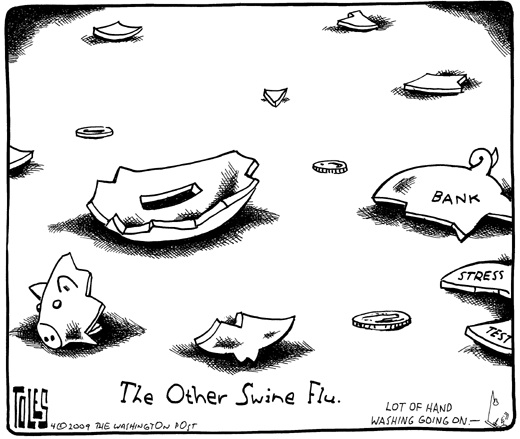
Cartoon by Tom Toles, Washington Post
Posted by Larry Doyle on May 1st, 2009 5:21 PM |
Cartoon by Tom Toles, Washington Post
Posted by Larry Doyle on May 1st, 2009 1:09 PM |
Analysts and economists are pointing toward a near term decline in prices while raising concerns about inflation down the road. Disinflation (a slower pace of inflation) or deflation (an actual decline in prices) are a crushing blow to a company’s bottom line. That said, companies are incentivized to discount prices in order to move inventory. Consumer discretionary items are much more subject to discounted prices than consumer staples.
My better half came home from the supermarket the other day commenting on definite increases in price on a wide array of basic staples. To that end, I am not surprised to read that Colgate and P&G are raising prices. Can price increases in the face of rising unemployment stick? Will consumers who have traditionally bought these brands change product loyalty? The WSJ reports, P&G, Colgate Hit by Consumer Thrift.
If price checking is not already part of your regular exercise when shopping, it should be. Make no mistake, raising prices at this juncture is a high risk proposition for Colgate, P&G, or any other company. However, do not be surprised to see more slight price increases on staples along with slight declines in product sizes.
What prompted some of these price increases? The WSJ reports:
To offset higher commodity prices and global currency swings, P&G and Colgate raised prices in the quarter through March. P&G said higher prices increased its total sales by 7%. Colgate raised prices by 8%.
Despite pressure from retailers to lower prices for cash-strapped shoppers, neither company conceded much willingness to do so.
Higher prices hurt sales volumes, especially in emerging markets, but still paid off for the companies.
“While painful, pricing to protect the structural economics of our business is the right thing to do,” P&G Chief Financial Officer Jon Moeller said.
Analysts said higher prices could backfire. “Investors are certainly concerned by unit-volume trends, especially on the Procter side, and wondering whether they’re going to have to lower price points or kick up promotions,” said Bill Pecoriello, CEO of ConsumerEdge Research LLC, a consumer-products research boutique in Stamford, Conn.
While impulse buyers like myself are a retailer’s dream, it is obviously prudent to comparison shop. However, if we see ongoing increases in commodity prices and volatility in currencies, (both of which are likely to occur in the face of massive deficit spending), these price increases may be more the norm than the exception.
Don’t be surprised if stockpiling of goods becomes a prudent discipline.
LD
Posted by Larry Doyle on May 1st, 2009 8:52 AM |
In my April 2009 Market Review, I commented on how Uncle Sam is not a good business partner. Business Wire issued the following statement from Chrysler’s Non-TARP Lenders:
NEW YORK–(BUSINESS WIRE)–As of last night’s deadline, we were part of a group of approximately 20 relatively small organizations; we represent many of the country’s teachers unions, major pension and retirement plans and school endowments who have invested through us in senior secured loans to Chrysler. Combined, these loans total about $1 billion. None of us have taken a dime in TARP money.
As much as anyone, we want to see Chrysler emerge from its current situation as a viable American company, and we are committed to doing what we can to help. Indeed, we have made significant concessions toward this end – although we have been systematically precluded from engaging in direct discussions or negotiations with the government; instead, we have been forced to communicate through an obviously conflicted intermediary: a group of banks that have received billions of TARP funds.
What created this much-publicized impasse? Under long recognized legal and business principles, junior creditors are ordinarily not entitled to anything until senior secured creditors like our investors are repaid in full. Nevertheless, to facilitate Chrysler’s rehabilitation, we offered to take a 40% haircut even though some groups lower down in the legal priority chain in Chrysler debt were being given recoveries of up to 50% or more and being allowed to take out billions of dollars. In contrast, over at General Motors, senior secured lenders are being left unimpaired with 100% recoveries, while even GM’s unsecured bondholders are receiving a far better recovery than we are as Chrysler’s first lien secured lenders.
Our offer has been flatly rejected or ignored. The fact is, in this process and in its earnest effort to ensure the survival of Chrysler and the well being of the company’s employees, the government has risked overturning the rule of law and practices that have governed our world-leading bankruptcy code for decades.
We have a fiduciary responsibility to all those teachers, pensioners, retirees and others who have entrusted their money to us. We are legally bound to protect their interests. Much as we empathize with Chrysler’s other stakeholders, the capital is just not ours to contribute to their cause by accepting a deal that is outside the well established legal framework and cannot be rationalized as being commercially reasonable.
We are continuing to discuss our position with the United States Treasury. We have made a proposal which we earnestly believe is fair and would appropriately recognize our legal position.
As President Obama implied yesterday, it is likely that Chrysler will have to file Chapter 11 whether or not all lenders agree to any particular proposal. Chapter 11 is often used to help implement an agreed deal and dispose of unwanted legacy liabilities. We are hopeful and optimistic that we will reach a positive resolution of our issues so that all stakeholders will move forward together to implement Chrysler’s “quick trip” restructuring in an un-contested proceeding. Our Group will never initiate a bankruptcy filing on Chrysler – that is a decision for the Company and the Administration to make.
As we all appreciate, laws are the foundation of our economy and society. Despite recent travails, our country remains the economic envy of the world and the United States remains a vital engine of global growth. The rule of law made it that way. We urge that people remember this and not succumb to unproductive and unwarranted finger pointing.
Sincerely,
The Committee of Chrysler Non-Tarp Lenders
This statement speaks for itself. My only comment is in regard to the creditors’ final assertion. Chipping away, if not crushing, the rule of law in our economy and society will come at a VERY HIGH price. I believe government representatives are misinformed and unappreciative of that price. I encourage investors and the public at large to remain vigilant and vociferous on this issue.
Please start by sharing your your thoughts and sentiments here.
LD
Posted by Larry Doyle on May 1st, 2009 5:00 AM |
Does the economic activity in April 2009 represent a turning point in the recession which started in December 2007? Does the continuing rebound in the equity markets represent a bright light at the end of the tunnel or merely a rebound from a very oversold market? Have global risks abated or are they being masked by massive government intervention? Let’s get after it.

In my opinion, we are in the early stages of transition to a new global economic dynamic. That process includes:
1. Strict discipline in underwriting. Banks are forced to underwrite to own as opposed to underwrite to sell. The shadow banking system (loans originated to be securitized and sold) is dead as we knew it. Banks have certain assets marked way too cheaply while also carrying plenty of fraudulently underwritten loans worth far less than their mark. Growth potential for the economy as a whole will remain constricted by a lessened flow of credit. There will be a clear distinction in companies which are winners and losers in this process.
2. Lessened consumer demand on a going forward basis.
3. Challenges for companies relying on debt financing and opportunities for companies generating free cash flow. The model based on leveraged finance is dead and not soon to return. Automotive companies need a 13 million rate of unit sales to break even. Without a shadow banking system, I don’t see this happening.
4. Opportunities for consumers buying homes. Don’t expect a rebound in home price appreciation as foreclosures, which were forestalled by banks and Freddie and Fannie, will add supply to the housing market. Housing may stabilize, but I do not think it will improve given the glut of unsold homes.
5. Continued increase in unemployment will keep consumers cautious.
6. Many analysts focused on inventory drawdown in the latest GDP report as being a positive for future growth. Why didn’t analysts highlight the fact that consumer spending was actually a positive 2.2%? Does that statistic represent a return of the consumer? In my opinion, NO. The positive consumer spending was primarily focused on massive price discounts offered in January and February to move product after anemic holiday sales. Personal spending for March was released yesterday morning and came in at -.2%. March retail sales were a surprisingly weak -1.1%.
7. Government intervention in markets may be viewed as necessary in the short term, but a persistent government presence in markets and industries comes with unknown, and in my opinion, very high costs. We are seeing heightened challenges in banking, insurance, automotive, and soon health care, energy, and education. Companies, consumers, and investors will be forced to adapt to a regular presence of Uncle Sam. He is not a good business partner.
8. There is a very distinct shift in economic power towards China and with it a shift in political power, as well. I believe it is a question of when – not if – in terms of a major European country defaulting on its debt and requiring a rescue from the EU and/or IMF.
9. I still see a steady dose of analysts and economists forecasting future economic activity based on past models. I think they are missing the big picture. I believe we need to forecast economic activity based upon traditional bank lending. If the government persists in trying to fill a void which naturally is not there, the risk involved in that undertaking is hyperinflation.
Again, I am happy the markets have rebounded from the lows of early March but in looking forward I see a dramatically different economic landscape than our recent past. People who are able to adjust to that will do fine. People who are trying to maintain a lifestyle predicated on the economy of 2003-2007 will be very frustrated.
As far as my market call, I remain very concerned about the prevailing level of interest rates. I think the market will test the resolve of the Fed to continue to effectively overpay for mortgage and government securities.
In regard to the equity market, we are only 3-7% away from the S&P and DJIA being unchanged on the year. If we do get there, I think it would be a good opportunity to sell positions. I believe the next 10% move will be to lower prices.
In short, I think the delevering process has been given a significant breather due to Uncle Sam’s checkbook but that it is not yet over.
What do you think? There is plenty here for everybody. Please share your thoughts.
LD
Posted by Larry Doyle on April 30th, 2009 3:00 PM |
Friends of mine have asked me to explain some of the dynamics involved in the government rescuing of our banking system, equity markets, and economy as a whole. Allow me to share with you the following analogy I gave them.
A patient in distress enters surgery and badly needs a blood transfusion. The blood in our economy is transferred via massive increases in deficit spending funded from borrowing in the government bond market. The same sort of operations are occurring in every major country and region literally around the world. The overall blood donor supply is not limitless. In withdrawing the blood from the government bond market, other patients (consumers, corporations) have found blood to be in very short supply and they have suffered as a result.
We all know that blood can regenerate. Are the “green shoots” in our economy a result of “blood doping,” in which the patient regenerates his own blood even in the midst of the transfusion? Blood doping is a very dangerous procedure. When should the patient become a blood donor rather than a blood recipient?
Are our surgeons talented enough to know when and how to precisely withdraw the blood? Does the patient run the risk of another much more serious condition from excessive blood flow? No doubt.
Who on our staff is practiced in the art of withdrawing blood? Paul Volcker was chair of the Fed in the early 1980s when inflation ran rampant. He increased the heart rate monitor known as the Fed Funds rate to near 20% in order to choke off the inflation monster.
Without referencing a specific target Fed Funds rate, Volcker remarked yesterday that an overheated patient this go round may also require similar treatment.
LD
Posted by Larry Doyle on April 30th, 2009 11:00 AM |
Will the Democratic Congress supported by the Obama administration use a process known as “reconciliation” to pass health care legislation? Reconciliation allows for passing legislation by a simple majority in the Senate instead of the standard 60 vote margin. In so doing, Obama and the Democrats will likely pass this legislation without real debate.
The process has never been used to pass new legislation of the magnitude of health care reform. By all measures, the reconciliation process was never intended to be used in this manner. Obama and the Democratic leadership maintain that the Bush administration used reconciliation to pass tax legislation. The Republicans respond by claiming that in those cases reconciliation was used to renew existing legislation and not of the magnitude or importance of health care reform.
Are Obama and the Democrats forgoing any form of debate on this issue and jeopardizing any sort of honest bipartisan politics moving forward? I believe so.
The UPI provides further color on this topic, Dems to Use Reconcilation For Healthcare.
Is there any doubt that Obama is hellbent on passing this legislation regardless of future risks to political procedures. Will this healthcare legislation be written in the same manner as the Economic Stimulus bill jammed through Congress? The UPI reports,
Even though Republican leaders have warned Democrats against using the tactic and others say it may hinder future legislation where bipartisan consensus is needed, Obama Thursday reiterated his support for the move in a meeting with congressional leaders, White House and Capitol Hill sources told the Times.
The president and his congressional allies believe using the budget reconciliation process to pass healthcare reform may be the only way to implement measures that have eluded lawmakers for years, the newspaper said.
Given Arlen Specter’s switch of parties, I honestly believe the only real check on Democratic spending at this juncture may be polls from currently controlled Democratic states showing significant voter unrest.
I view the use of the reconciliation process as just another step towards our political process in Washington being totally out of control….and it will be expensive to clean up!!
LD
Posted by Larry Doyle on April 30th, 2009 5:45 AM |
The equity markets have rebounded significantly over the last seven weeks. The Dow and S&P are now down approximately 4-6% on the year. The tech heavy Nasdaq has distinguished itself and is up approximately 10% on the year.
At this juncture, if the equity markets are implying that the economy will not slip into Depression, then the bill for the stability in equities is being transferred to participants in the bond market. Government bonds are facing an almost weekly avalanche of tremendous supply. This week the market is absorbing over $100 billion in 2yr, 5yr, and 7yr Treasury securites. Take a deep breath and next week the market is faced with over $75 billion in 3yr, 10yr, and 30yr government securities. The Treasury is likely going to sell 30yr government debt on a monthly basis!!
The Federal Reserve has been the biggest buyer of Treasury and mortgage-backed securities. The Fed’s balance sheet may be large but it is not endless. What have 10 yr. Treasury securities done on the year? Even in the face of massive buying of these securities by the Fed, the 10yr has backed up almost 1% to a current level of 3.1%. That rise in rates is very significant.
I have maintained and continue to maintain that interest rates will move higher given the overwhelming demand for funds by global governments to pay for deficit spending. Central banks around the world may try to hold the respective bond markets up and interest rates down but investors will continue to demand a higher rate of interest in the process.
As government rates move higher, mortgage rates, and other corporate rates will likely move higher as well. If we get a whiff of early signs of inflation which I believe is coming these rates could ratchet higher and the bubble in the government market would not merely burst but would actually explode.
LD
Posted by Larry Doyle on April 29th, 2009 7:15 PM |
Hasn’t the public had enough of excessive compensation and abusive bonus practices for employees of organizations saved by Uncle Sam? Why and how is it that Citi Seeks Approval to Pay Out Bonuses.
Vikram Pandit, the CEO of Citigroup, and every other executive at Citi needs to know that as wards of the state, you earn a government wage. While Vikram and team may decry the dissolution of their franchise, they need to wake up and smell the coffee. There would be no franchise at Citi without the taxpayer having injected tens of billions of dollars.
Citi employees took the risk in choosing to work at the firm just as any employee takes company risk in any firm. If any Citi employee wants to leave, my advice is “don’t let the door hit you on the way out.” Citi management may believe it is critical to the franchise to retain these employees in order to generate earnings and repay the government. My response is that with a Fed Funds rate at 0% and lending rates of between 5-20%, Citi will generate earnings without the risks embedded in proprietary trading.
If Citi can sell a division intact to generate income, why aren’t they already pursuing it? The WSJ offers further color:
Citigroup is trying to get U.S. approval for special bonuses for many of its employees. In a meeting earlier this month with Treasury Secretary Timothy Geithner, Citigroup CEO Vikram Pandit made the case for the stock-based bonuses. Executives are describing the bonuses as “retention” awards to perk up demoralized employees who the company worries are vulnerable to poaching by rival firms, people familiar with the matter said.
A person familiar with Mr. Geithner’s thinking said the Treasury hadn’t made a decision on whether to allow the bonuses. It is unclear how much Citigroup would pay out in bonuses if the government approved the move. A Citigroup spokesman declined to comment on details of the proposed compensation plans.
Citigroup’s request comes after Congress, the public and the president blasted pay practices on Wall Street. Bonuses at American International Group Inc. and Merrill Lynch & Co. ignited political infernos in Washington.
Citigroup has already gotten its own share of criticism for excessive spending, thanks in part to its aborted plans earlier this year to buy a new corporate jet. The company has received $50 billion in taxpayer aid, and the U.S. government is protecting Citigroup against most losses on $301 billion of its assets. The Treasury is poised next month to become Citigroup’s largest shareholder, owning as much as 36% of its common stock.
Why is this issue even being aired? Why hasn’t Turbo-Tim told Vikram and team, the answer is “NO.” Two letters, “N” and “O”. Which one of those don’t they understand?
LD
Posted by Larry Doyle on April 29th, 2009 2:57 PM |
The Federal Reserve released its regular statement on the economy at 2:15pm. The statement includes:
1. no change in the Fed’s interest rate policy with the Fed Funds rate remaining between 0-.25%.
2. no change in the Fed’s asset purchase program of government and mortgage-backed securities.
3. overall economic activity remains weak but the pace of decline is slowing.
4. inflation remains below the Fed’s long term target.
5. the Fed will employ all available tools at its disposal to help the economy recover.
The equity markets are having a strong upward move today based not on the Fed’s statement but reaction to the DRAMATIC decline in inventories reflected in this morning’s VERY weak GDP report. If an equity market rallying after a VERY weak GDP report seems counterintuitive it is due to the fact that if and when consumer demand picks up it will drive production.
In my opinion, banking on a pickup in consumer demand is a big if. With credit tight and likely to remain tight, I believe our economy needs to and will adjust to lessened demand.
The WSJ comments on this economic activity, U.S. Economy Shrank At 6.1% In First Quarter:
Weaker investment in housing combined with the enormous inventory adjustment to pull the economy downward. But the aggressive drawdown of stockpiles of goods, while hurting the economy in the short run, is beneficial because it is an important step toward bringing inventories under control and ending a production freefall. U.S. industrial production retreated a fifth straight month in March, recent data show. Over the past 12 months, output was down nearly 13%. Capacity use by industries receded to 69.3%, a historical low since records began in 1967.
One area of concern for me is the uptick in prices. Although economists and analysts are panning the near term inflation risks, in my opinion, this risk should not be underestimated. The increase in prices in today’s GDP report has received little coverage, but
Price indicators within Wednesday’s report suggested inflationary pressures rose in first-quarter 2009, easing fears of deflation. For instance, the price index for personal consumption expenditures fell by 1.0%, a decline much smaller than the fall of 4.9% in the fourth-quarter 2008. The PCE price gauge excluding food and energy rose 1.5%, after increasing 0.9% in the fourth quarter.
Free money in the form of a 0-.25% Fed Funds rate will continue to help banks recover but government deficits as far as the eye can see must be addressed. If the economy stabilizes, look for interest rates to ratchet higher.
In fact, in today’s trading government bonds are down and rates are back to the highs seen last November.
LD
Posted by Larry Doyle on April 29th, 2009 6:52 AM |
I have written extensively about FINRA’s ownership of Auction Rate Securities over the last few months. This morning Bloomberg reports, FINRA Oversees Auction-Rate Arbitrations After Exiting Market.
The Bloomberg article (I am humbled by Bloomberg quoting me in the story) answers a number of questions I have raised, while also opening the door to other issues needing to be addressed:
1. Was FINRA blinded – if not totally conflicted – in addressing the trading, selling, and marketing of Auction Rate Securities? Try 862 million times.
2. Was FINRA lucky, prescient, or well informed in the timing of the sale of their own Auction Rate Securities? We may never know but given that their first “guidance for investors” was not published until after the market had totally frozen, they certainly did not provide much investor protection as is their mandate.
3. I have also written, and Bloomberg highlights, that FINRA had money invested in hedge funds. In light of market developments, I think the public has a right to know which hedge funds. Will FINRA release that information?
4. I unearthed all the information of FINRA’s investment activities from its 2007 Annual Report published in April 2008. I am still waiting for FINRA to release its 2008 Annual Report and wonder why it seems to be delayed.
5. As we move forward with likely regulatory changes for Wall Street, I believe the very nature of a self-regulatory organization funded by the banks it is charged to oversee presents massive conflicts of interest. This specific situation of FINRA’s investment in ARS is indicative of those conflicts. Will Congress have the courage to address these conflicts and serve the public interest in the process?
“To me it smacks of incompetence and negligence,” said Larry Doyle, who worked 23 years on Wall Street and runs a Web site called Sense on Cents. “Finra is supposed to police the market.”
I view FINRA as akin to the palace guard. The question remains, Does The Palace Guard Have No Clothes?
LD


