RSS Feed
 Twitter
 Facebook
 Email
Email Home
HomeAs California’s Economy Goes, So Goes the Country
Posted by Larry Doyle on May 12th, 2009 5:15 PM |
Political hacks assert, “all politics is local.” In a similar vein, armchair economists propose, “as California goes, so goes the country.” Why is that? California represents such an enormous part of our country in many respects, including the following:
– 8 of the 50 largest cities
– population of approximately 37 million people (that we know of), a full 12% of our national population
– an economy similar in size to Italy, ranking it as one of the top 10 in the world (I have seen rankings of 8th and 9th)
– California’s economic output represents 13% of our national GDP!!
– an unemployment rate north of 11% compared to the national average of 8.9%. With a high unemployment rate amongst illegal immigrants, it is not a stretch that California’s unemployment rate is approaching 15% and its underemployment rate is greater than 20%!!
The results of the Bank Stress Tests indicated that Bank of America and Wells Fargo had the greatest capital shortfalls. Why is that? BofA already had a huge market share in California and it grew exponentially with its purchase of Countrywide. Wells Fargo also had huge market share in California and it only grew with its purchase of Wachovia. Hey LD, Wachovia is a North Carolina based bank, how could that correlate into increased California exposure? Wachovia purchased Golden West Financial, a southern California based bank which had been one of the most aggressive lenders of a mortgage product known as pay-option ARMs. Suffice it to say that product has been a disaster in terms of delinquencies, defaults, and foreclosures.
Earlier this year, California faced a massive budget shortfall and experienced significant political turmoil in passing a budget. Well, the Governator Arnold Schwarzenegger is right back in the ring as California’s fiscal situation is faced with more sinkholes. The WSJ reports, Cuts Loom in California if Propositions Fail.
While politics may be local, the economic fallout from California can not be walled off from the rest of the country. The capital cushions that BofA, Wells Fargo, and many other banks are forced to set aside against consumer, corporate, and municipal defaults literally ripple across our entire country. The WSJ reports:
California’s fiscal plight is worsening. In a letter sent Monday to the state’s legislative leaders, the governor said the Golden State now projects a new $15 billion shortfall, up from a previous estimate of $8 billion, because of plummeting tax revenue amid the recession. That figure would jump to $21 billion if Californians next week defeat the propositions, Mr. Schwarzenegger said.
Professors Ken Rogoff and Carmen Reinhart, in a dissertation, “Aftermath of Financial Crises,” highlighted declining tax revenues as one of the driving forces to increased fiscal deficits, greater government borrowing, further crowding out, and an underperforming economy. While the Governator is locked in a battle with the legislature, municipal unions, and other constituencies over the state’s fiscal follies, is California an opening act to the same show in Washington over the next few years?
Would our friends from California please share some perspectives? I thank you.
LD
Does HSBC See Green Shoots?
Posted by Larry Doyle on May 12th, 2009 11:41 AM |
Are those green shoots or dandelions or a mix of the two?
As the “lawn” comes in, we hope the roots grow deep and the grass is lush. That said, we can not blindly accept a prospective landscaper’s vision of what our yard may look like next quarter or later this year.  I don’t subscribe to using products like Miracle-Gro. Given that virtually every “gardener” is employed or connected to “Uncle Sam’s Lawn Patrol,” who else can give us a “lay of the land”? Let’s talk to the gardeners at HSBC!
HSBC purchased Household Finance in 2003. I am sure they regret making that purchase. HSBC was trying to emulate the “originate to distribute” model which filled the coffers of so many other Wall Street banks. The fact is, though, HSBC was literally the last entrant to the “lawn” party and their experience has been nothing short of a whole lot of crabgrass.
As the WSJ reports, HSBC Points To More Pain In U.S., we receive a diagnosis on the U.S. economy that is much less sanguine but, in my opinion, more realistic than Uncle Sam’s gardening crew. The WSJ highlights the fact:
HSBC, which was among the first banks to signal the subprime-mortgage troubles that set off the global financial crisis, said its U.S. consumer-finance operation had seen a slight slowdown in the deterioration of its mortgage and other secured loans in the first quarter compared with the fourth of quarter of 2008 — a shift executives attributed in part to U.S. tax refunds, higher savings rates and the bank’s efforts to help borrowers by changing the terms of their loans.
While those signs of a slowdown in loan deterioration may be viewed as a “green shoot,” HSBC is an honest “gardener” and allows that the positive trend may not continue.
North America Chief Executive Brendan McDonagh attributed the change to several factors, including a seasonal bounce, tax refunds, loan modifications and the bank’s previous efforts to pull back in mortgage lending. “We are slightly encouraged by it, but I am reluctant to draw too many conclusions,” Mr. McDonagh said.
HSBC Chief Executive Michael Geoghegan said loan-loss rates could increase again in the third or fourth quarters of the year. “We expected two difficult years in consumer finance over all,” he said.
Given the fact that HSBC is not connected to Uncle Sam’s gardening, I appreciate the honest assessment and “more realistic” prognosis. Miracle Gro may sell well on late night TV, but I prefer a “gardener” who is straight and honest while informing me that it may be a few years before the lawn comes in.
Speaking of lawns and gardening, here’s a shout out to my good friends Rocky and his pop!!
LD
Banks: What Lies Ahead?
Posted by Larry Doyle on May 12th, 2009 7:34 AM |
If the major money-center banks are neither going to be nationalized nor fail, at least for the time being, then what does the future hold for these institutions? Uncle Sam has provided massive backstops via a number of programs, but a socialized banking system is not consistent with free market capitalism.
Fed chair Bernanke addressed the three major risks — operational, liquidity, reputational — for these institutions moving forward. Let’s address each individually.
1. Operational: While Uncle Sam (Fed and Treasury) has done a lot (some would say too much) for the large banks, he can’t literally run the banks. With no “shadow banking system” (please read “All The King’s Horses and All the King’s Men“), reluctant consumers, and defensively postured corporations, how do the banks manage their increasing level of loan defaults? On top of that, how do they actually grow their business when, by necessity, they are forced to cut their own expenses?
Banks can only “massage” their numbers via the relaxation of the mark-to-market accounting rule for a brief period. While a few of these institutions have large capital market businesses which have recently provided solid returns, those are high risk operations and earnings from that division are volatile. Underwriting fees for new issues of debt and equity were at record lows in the 1st quarter 2009.
Will banks be able to manage their traditional “bricks and mortar” operations (underwriting and holding quality loans) and generate long term growth in this sector? Good question and a real risk.
2. Liquidity: Without Uncle Sam backstopping the short term markets, will banks be able to source sufficient daily liquidity to manage and grow their business units? Bernanke is setting the stage for the time when the Fed needs to drain liquidity from the system so the inflation monkey – if not the hyperinflation monster – does not spin out of control. (please read “Putting The Genie Back Inside the Bottle“)
In layman’s terms, how does the Fed wean the banking system from the drugs that have kept it alive? Will some of the banks be zombie-like, if not outright brain dead? Would we have been better off letting certain institutions fail? If banks can’t source their own liquidity to “live a healthy life,” perhaps Uncle Sam has been more of a benevolent old man when a strict disciplinarian was more in order.
3. Reputational: If banks are challenged to grow and source liquidity without Uncle Sam’s assistance, will they start to cut corners, and once again push the envelope out of desperation for earnings? Please read, “The Greatest Risk,” a recap of the risks undertaken by Bear Stearns, which played a major role in that 100 year old firm’s downfall. Desperate people do desperate things and similarly desperate institutions will also do desperate things. We have already seen ample evidence of extreme measures taken by banks to jeopardize the reputation of the institution in pursuit of the almighty dollar. In this realm, who will be watching? What type of regulations will be implemented and enforced?
On all these fronts, the risks faced by the banks are significant. The risks faced by consumers are also significant. If there is one thing we have learned throughout this ordeal, it is the fact that we can not blindly trust what executives of banks, as well as other institutions, lead us to believe. We must probe, look beyond the numbers, and seriously question the integrity of the data. If we don’t, then we increase our own risks as we navigate our own personal economic landscapes.
LD
Allen Stanford and Whitey Bulger: Two Peas In a Pod?
Posted by Larry Doyle on May 11th, 2009 2:58 PM |

Allen Stanford and Whitey Bulger
Are Allen Stanford and Whitey Bulger two peas in a pod? For those unfamiliar with Whitey, he is Boston’s greatest gangster, a government informant who simultaneously continued to run his gangland activities, one of the FBI’s Most Wanted, and still on the lam. The Martin Scorsese film, The Departed, was largely based on Whitey and his boys. If Whitey dealt in drugs and murder, is Stanford Financial, operated by Allen Stanford, a financial version of a government cover totally run amuck?
We all know the SEC totally dropped the ball in the oversight of the Bernie Madoff Ponzi scheme. On the heels of that and to alleviate massive pressure on the commission, the SEC quickly moved on Allen Stanford.
MAJOR hat tip to MC of Investor Rebellion in sharing with me a story broken by the BBC, Stanford Drug Informer Role Claim:
Evidence has emerged that the Texan who bankrolled English cricket may have been a US government informer.
Sir Allen Stanford, who is accused of bank fraud, is the subject of an investigation by the BBC’s Panorama.
Sources told Panorama that if he was a paid anti-drug agency informer, that could explain why a 2006 probe into his financial dealings was quietly dropped.
Sir Allen vigorously denies allegations of financial wrongdoing, despite a massive shortfall in his bank’s assets.
But the British receiver of his failed Stanford International Bank – based in Antigua – told Panorama that the books clearly show the deficit.
If in fact this development is accurate, has the U.S. government, via the DEA, facilitated a Ponzi scheme? I am not so naive as to think that there aren’t massive undercover operations ongoing regularly to infiltrate and expose illicit activities. However, if in fact that were the case, how did the DEA lose control of Stanford’s investment activities? Is this situation an indication that the Obama administration will not partake of these types of undercover operations? Is there a massive in-house brawl currently ongoing between the DEA and the SEC?
The BBC reports:
Secret documents seen by Panorama show both governments knew in 1990 that the Texan was a former bankrupt and his first bank was suspected of involvement with Latin American money-launderers.
In 1999, both the British and the Americans were aware of the facts surrounding a cheque for $3.1m (£2.05m) that Sir Allen paid to the Drug Enforcement Administration (DEA).
It was drug money originally paid in to Stanford International Bank by agents acting for a feared Mexican drug lord known as the ‘Lord of the Heavens’.
The cheque was proof that Stanford International Bank had been used to launder Mexican drug money – whether or not Sir Allen knew it at the time.
On 17 February of this year, the US Securities and Exchange Commission (SEC) accused Sir Allen of running a multi-billion dollar Ponzi fraud – when cash from new depositors is used to pay dividends to old depositors – civil charges he has denied.
Two and a half months after the SEC filing, the Texan has not yet faced criminal charges.
He was initially investigated by the SEC for running a possible Ponzi fraud in the summer of 2006, but by the winter of that year the inquiry was stopped.
Is this another version of the Whitey Bulger story in which the criminal turned informant continues to operate his own illicit activities? Whitey is now on the lam and his FBI protection, John J. Connolly, is cooling his heels in a federal penitentiary.
The intrigue of this situation is surreal, but the natural and instinctive question has to be: if Uncle Sam (DEA) provided cover for Allen Stanford in the pursuit of illicit drug related activities, did Uncle Sam also provide cover for Bernie Madoff as well?
LD
NASD Knew Auction Rate Securities Weren’t Cash
Posted by Larry Doyle on May 11th, 2009 10:45 AM |
Everybody knows Auction Rate Securities (ARS) were cash or cash-like, correct? FINRA certainly did NOTHING to protect investors from the ARS sales and marketing scam perpetrated on investors.
FINRA spokesman Herb Perone would like to wash his hands and those of FINRA of any negligence or incompetence in regard to FINRA’s investments in Auction Rate Securities. The easiest manner of washing one’s hands is to point the finger at the entity which initially made the investment, in this case the NASD (National Association of Securities Dealers). If you recall, FINRA was formed in mid-2007 from the regulatory arms of the NYSE and NASD. In any event, Perone tries to deflect culpability on FINRA’s part in the recently reported Bloomberg story (FINRA Oversees Auction-Rate Arbitrations After Exit) highlighting FINRA’s sale of their Auction Rate Securities prior to the market’s implosion leaving thousands of investors and billions of dollars frozen. Bloomberg reports:
“The market was functioning normally when NASD was investing in these securities,” Perone said. At the time, auction-rate securities “were viewed as high-quality cash equivalents and as acceptable investment for institutions,” he said.
Perone further offers:
“It was for cash that we needed to have parked for a temporary period of time,” Perone said. “It was common to take cash you needed to hold and put it in auction-rate securities.”
If ARS were viewed as high-quality cash equivalents, why didn’t the NASD actually account for them in that manner? The NASD goes out of its way in its Annual Reports for 2003-2005 to highlight the fact that ARS were not cash or cash-like.
From page 38 of the NASD’s 2005 Annual Report, published on May 10, 2006:
Available-for-sale investments also include investments in auction rate securities, which are either preferred stock or bonds with interest rates that reset periodically, typically less than every 90 days, based on a Dutch auction process. Given the longer-term maturities of these securities, they are classified as available-for-sale investments, rather than cash and cash equivalents.
From page 30 of the NASD’s 2004 Annual Report, published on April 29, 2005:
Available-for-sale investments also include investments in auction rate securities, which are either preferred stock or bonds with interest rates that reset periodically, typically less than every 90 days, based on a Dutch auction process. Given the longer-term maturities of these securities, they are classified as available-for-sale investments, rather than cash and cash equivalents.
From page 27 of the NASD’s 2003 Annual Report published on June 7, 2004:
Available-for-sale investments also include investments in auction rate securities, which are either preferred stock or bonds with interest rates that reset periodically, typically less than every 90 days, based on a Dutch auction process. Given the longer-term maturities of these securities, they are classified as available-for-sale investments.
I have been questioning whether FINRA was negligent, incompetent or both in regard to their investment in ARS. FINRA could not have been negligent. Their parent organization, the NASD, lays it out in three separate Annual Reports that ARS were not cash or cash equivalents.
Thus, FINRA was merely incompetent in not protecting investors, as is its mandate!!
How may this be adjudicated? It is now speculated that Uncle Sam may establish a liquidity facility which investors can tap to get their money. This liquidity facility may be part of a larger government entity. I do hope this facility is enacted and that ARS investors can receive a timely return of their funds.
However, to whom does the obligation and cost shift? The American taxpayer. Once again, the taxpayer may pick up the tab for an activity (the sales and marketing of ARS by banks and investment managers) deemed a fraud by federal judges.
LD
Scoundrel Hedge Funds? Don’t Just Stop There
Posted by Larry Doyle on May 11th, 2009 6:40 AM |
Hedge funds are bad guys, right? Greedy, unethical, opaque, right? Well, hedge funds are largely opaque and that needs to be addressed in order to make sure that trading and investment activity occurs in an ethical fashion. That said, hedge funds are like any other industry; there are some bad seeds mixed in with plenty of outstanding individuals. Do the bad seeds warrant an industrywide assault? I don’t think so, but that is what we are seeing from the Obama administration on the heels of the Chrysler bankruptcy.
I see the issues in the hedge fund as follows:
1. This industry should be required to pay taxes on income generated at ordinary income tax rates instead of as carried interest and thus at long term capital gains rates. The Obama administration has looked to implement this change in their budget. This move is long overdue.
2. The industry should be regulated and/or regularly monitored. Why regular oversight did not occur after Long Term Capital Management imploded in 1998 is beyond the life of me. Who may monitor them? A division within the SEC. (for those interested in the topic of hedge funds and Wall Street oversight, a must read is When Genius Failed: The Rise and Fall of Long Term Capital Management by Roger Lowenstein)
The collapse of LTCM in 1998, a mere 5 years after its founding, exposed many of the problems within the hedge fund industry. Although the principals in LTCM were not bailed out, the process of unwinding that firm was viewed as a Fed orchestrated takeover. Many moral hazards were violated. Many shoddy business practices were exposed. Very few real regulatory changes were implemented. There is no doubt in my mind that the manner in which LTCM was handled set the precedent for many of the problems of the last few years. (I wrote extensively about this topic in my March 18th piece: “AIG and LTCM“)
It has always been widely speculated that many Wall Street firms profited handsomely from the LTCM debacle. How so? Representatives from each firm were involved in a committee that took over the LTCM operations. In the process, firms became aware of the vulnerability of market sectors in which LTCM had significant exposure. Traders at firms drove markets in one direction or another to further LTCM’s pain. There is no doubt we have experienced similar scenarios recently. Goldman Sachs, rightly or wrongly, is typically the firm implicated for this activity.
3. Hedge funds are the most active traders in the marketplace. A large number of traders within hedge funds came from Wall Street banks and maintain close relationships at the banks. Additionally, hedge funds also have close relationships amongst themselves. Dare I say, without aggressive oversight, the system allows and effectively engenders coordinated if not collusive trading activity. This is not a new development.
4. Often traders from hedge funds transact business directly with traders at Wall Street banks without a salesman involved to act as an intermediary. This type of business is a compliance violation. Hedge funds want access to information from traders rather than salespeople who filter it or do not fully understand it.
5. I am very suspect that there are still a number of unexposed Ponzi schemes disguised as hedge funds. The fact that so many funds suspended redemptions is a sign the “flow of oxygen” to continue the scam had stopped. In fact, I would strongly suspect that a number of hedge funds farmed money to Bernie Madoff knowing full well the nature of Bernie’s business.
Are all these points an indictment of the entire industry? NO! As with any industry, there are plenty of unsavory and unethical charlatans. I could write a similar scathing review of illicit activities in banking, insurance, asset management, technology, politics (that would be a long one), and regulatory bodies.
The simple fact is hedge funds, in general, and the unsavory firms in particular, pushed the envelope because they were allowed. In fact, given the massive amounts of contributions which Washington politicians effectively commanded from them, it is not a stretch to propose that hedge funds were buying their own cover and protection.
In so many words, though, haven’t the large banks been operated as massive hedge funds as well? The banks utilized massive leverage, off balance sheet vehicles, active trading, and proprietary models to run their businesses. The banks also contributed massively to Washington coffers. Additionally, the banks funded their own regulatory oversight in the name of FINRA.
If banks operated as hedge funds, did the SRO (self-regulatroy oversight) FINRA also operate as a hedge fund? No, FINRA merely invested hundreds of millions of their OWN dollars in hedge funds and fund of funds. FINRA should be compelled to release the names of those funds. The circle is complete.
If Obama wants to castigate the hedge fund industry (WSJ reports Hedge Funds Are Piqued by White House) as being scoundrels and attempt to curry political favor with his constituencies in the process, he is morally bankrupt if he does not also address the complicit nature of the banks, politicians, and regulators as well.
LD
Happy Mother’s Day!!!
Posted by Larry Doyle on May 10th, 2009 8:00 AM |
Happy Mother’s Day to all the Moms who put the love into the relationships which make living worthwhile.
To those Moms in my life: from the mother of my children, my Mom, and my Mother-in-law, how did I ever get so lucky?
May today be filled with love and happiness for Moms everywhere . . . and then tomorrow we’re back to TARP, TALF, and Stress Tests . . . oh what fun!!
Enjoy!!
LD
NQR’s Sense on Cents with Larry Doyle Tonight at 8PM
Posted by Larry Doyle on May 10th, 2009 7:05 AM |
UPDATE: The show has concluded, but you can listen to a recording of it in its entirety by clicking the Play button on the audio player below. Once the playback has started, you can fast forward or rewind to any portion of the show by clicking at any point along the play bar.

************************************
 Please join me Sunday evening from 8-9 p.m. ET for NoQuarter Radio’s Sense on Cents with Larry Doyle. The developments in the markets, economy, global finance, Wall Street, and Washington are occurring at breakneck speed. I will try to slow things down a bit and provide a sense of perspective. What did we learn in the markets over the last week and what does that mean for the weeks and months ahead? We will address a wide range of issues.
 Tonight my guest will be Rick Johnson, author of Keep Your Assets. Take My Advice. Rick’s book focuses on providing sound advice to help protect investors from being victims of Wall Street’s shenanigans. After listening to tonight’s show, you will be “armed to the teeth . . . with the information you need to easily navigate through the perilous traps set by inexperienced and unscrupulous financial advisors” (from Rick Johnson’s website).
These are truly historic times in the global economy. Let’s “navigate the economic landscape” without the pandering or nonsense found elsewhere! What is on your mind? What would you like to address? Please share your questions and thoughts by calling in to (347) 677-0792, and also join our live chat room, which I’ll start up about 10 minutes before the show begins.
Many thanks to Larry Johnson and the rest of the team at NoQuarterUSA blog for providing such a vibrant vehicle as NoQuarter Radio. I look forward to having you join me Sunday evening as we collectively navigate the economic landscape!!
LD
The Big Lie
Posted by Larry Doyle on May 9th, 2009 1:00 PM |
These viewpoints are not widely disseminated by the mainstream media. The numbers don’t lie, however, and the level of defaults already being experienced on prime mortgages falls into the range (3-4%) of what Treasury designated as “worst case.”
Karl Denninger, at Market Ticker, writes a detailed, must-read sobering piece: Why We Are Absolutely Screwed
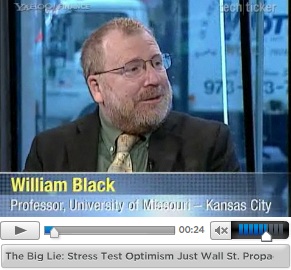
In addition, William Black – a former bank regulator – opines the lack of rigor in the bank stress tests. The 5-minute video clip, The Big Lie: Stress Test Optimism Just Wall St. Propaganda, is enlightening.