 RSS Feed
 Twitter
 Facebook
 Email
Email Home
HomeThe King of Wall Street: Larry Fink
Posted by Larry Doyle on June 17th, 2009 11:17 AM |

BlackRock CEO, Larry Fink
With the downfall of Wall Street over the last two years, we have seen some giants within the industry summarily dismissed and, in certain cases, demonized. Who knows what the future holds for Dick Fuld, Jimmy Cayne, John Thain, and Angelo Mozilo.
With their demise, who now reigns over the Wall Street kingdom? Many would debate that either Lloyd Blankfein of Goldman Sachs or Jamie Dimon of JP Morgan Chase is the “king of the court.” Well, Lloyd and Jamie certainly wield significant power and influence on Wall Street, but there is no doubt that the King of Wall Street is the CEO of BlackRock, Larry Fink.
Who is Larry Fink? What is BlackRock? How did he ascend to the throne?
I consider myself fortunate to have worked for Larry for the first 5 years of my career at First Boston. I learned the business under his watch. He was more than fair with me and I owe him a debt of gratitude for giving me an opportunity.
Larry came to Wall Street in the late ’70s and is largely credited, along with Lew Ranieri of Salomon Bros., for developing the mortgage-backed securities sector. First Boston and Salomon dominated the MBS sector of the market in the ’80s with a combined 70%-75% market share. I certainly did not fully appreciate it at the time, but my 7 years at First Boston were a fabulous education.
During my last two years at First Boston, I did not work for Larry. He moved on to join Blackstone, a new private equity venture. BlackRock was a part of Blackstone and subsequently spun off.
BlackRock was initially a shop that primarily marketed mutual funds. Over the last 21 years, BlackRock has experienced tremendous growth, both organically and via acquisitions. Just the other day, BlackRock purchased Barclays Global Investors for $13 billion. With BGI in the fold, BlackRock will have approximately $2.8 trillion in assets under management.
BlackRock typically gets the first call from Washington when workout situations arise. They were engaged to assess and manage the risks upon the demise of Bear Stearns and AIG.
BlackRock is recognized as the preeminent risk manager on Wall Street. In fact, one of BlackRock’s most profitable units is a risk management division known as BlackRock Solutions. How uncanny that BlackRock has flourished based upon its risk management capabilities. Why? Under Larry’s watch at First Boston in the mid to late ’80s, risk management within our MBS business was almost non-existent.
I would never air dirty laundry nor talk out of school, but Larry himself has referenced this time period as being a tremendous education for him along with a sore spot. Let me expound. (more…)
The Taxman Cometh
Posted by Larry Doyle on June 17th, 2009 7:07 AM |
How often during the campaign did we hear President Obama highlight that taxes would only increase for those earning incomes within the top 5%? You didn’t actually believe him, did you?
Yesterday, Obama played pure politics in backtracking from that “promise.” In an interview with Bloomberg, Obama Sees 10% Unemployment Rate, Chides Wall Street Critics:
He left open the possibility he would have to raise taxes on most Americans to decrease the deficit if growth were too weak. He also indicated he might tax the most-expensive employer-provided benefits to help pay for his health-care revamp. Both would reverse pledges he made during the campaign.
“If we are growing at a robust rate, then we can pay for the government that we need without having to raise taxes,” Obama said. “If we’ve got anemic growth, if we don’t have a strategy for recovery without bubbles, which is essentially what we’ve had over the last couple of recovery cycles, then we’re going to continue to have problems.”
What are Obama’s projections for unemployment and GDP?
Unemployment: 8.1% average in 2009, 7.9% average in 2010
GDP: -1.2% in 2009, 3.2% in 2010, 4% in 2011, 4.6% in 2012
No respected economist or analyst believes these numbers are credible. If anything, projections are only getting worse on both fronts. Obama, in a face saving move yesterday, admitted we will see 10% unemployment this year.
In regard to GDP, perhaps Obama should speak with Mohamed El-Erian at Pimco about the “New Normal” growth rate of 1% to 2% in the Brave New World of the Uncle Sam Economy.
What does it all mean?
The Taxman Cometh!!
LD
The Wisdom of Pete Peterson
Posted by Larry Doyle on June 16th, 2009 9:33 PM |
Pete Peterson is the son of Greek immigrants and has lived the American dream. He has held senior positions in Washington, run a Wall Street investment bank, and launched a major private equity shop. Peterson has been wildly successful in all his ventures. That said, his work is not finished.
This 12-minute Bloomberg video is one you will want to watch, save, cherish, and share. Peterson addresses the potential massive pitfalls of our “total” deficit, including Social Security and Medicare. He specifically references insights provided to him from foreign leaders.
He provides the wisdom of a man who has global relationships in the worlds of finance and politics. He grasps the depth of the issues facing our country. He is committed to making a difference and elevating the dialogue and debate surrounding our financial future.
Peterson, a son of “the Greatest Generation,” is a great American.
Please share this clip with friends and colleagues. They will thank you. ~ LD
Next Stop on the TARP Train: Philadelphia
Posted by Larry Doyle on June 16th, 2009 5:57 PM |
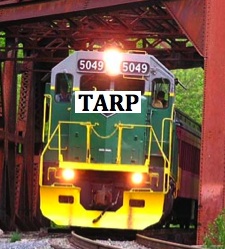 A week ago, ten of the larger financial institutions in our country announced they planned on returning billions in TARP funds. At that point, I wrote “Where Will TARP Money Go? Let’s Start in Hartford”:
Recall that Hartford was one of 6 insurance companies that received thrift status by acquiring a controlling stake in a small institution. As such, these firms became eligible for TARP funds. In my opinion, once the TARP dam is broken with one insurance company, the stigma is lessened for others to acquiesce in accepting these funds.
What might be the next stop after Hartford? Perhaps Newark (Prudential Insurance) or Philadelphia (Lincoln Financial). Sense on Cents will monitor where the TARP train moves next.
Well, the next stop on the TARP train is, in fact, Philadelphia as Lincoln Financial announces it will accept TARP funds. Financial Planning reports:
Just days after The Hartford Financial Services Group said it would accept bailout funds, Lincoln National Corp. announced it also will tap the government’s Troubled Asset Relief Program.
Lincoln National said it will accept as much as $950 million in capital as part of the government’s $700 billion program. The insurer previously had received approval to receive up to $2.5 billion from the government. Lincoln said it plans to determine the exact amount of government funds it will receive by the end of June.
The company also announced it will raise $600 million though a common stock offering, and raise $500 million through a senior debt offering.
Additionally, Lincoln said it plans to contribute about $1 billion to its primary insurance subsidiary, The Lincoln National Life Insurance Co. The remaining funds will be held at the holding company for general corporate purposes, including the repayment of short-term debt.
“Lincoln believes that participation in the CPP provides additional capital flexibility,” the insurer said in a statement released on its Web site. “The company expects to repay this financing as soon as practicable, taking into consideration appropriate balance sheet strength and capital markets conditions.”
Lincoln also announced today that it has signed a definitive stock purchase agreement to sell Lincoln National (UK) plc in order to shift capital to core U.S. businesses. SLF of Canada UK Limited will acquire Lincoln UK for an estimated £195 million. The transaction is expected to close on or around Sept. 30, 2009, subject to customary closing conditions.
Some may downplay or overlook Lincoln’s acceptance of a mere $950 million in TARP funds. That said, there is no doubt in my mind that this move by Lincoln – much like the move by Hartford Financial last week – is a clear indication that the insurance ‘dam’ is starting to break. What are the pressures within the insurance industry? Let’s revisit my post from March 12th, “Is My Insurance Insured?” I wrote:
While the government has already taken an 80% stake in AIG, how do the state insurance commissioners deal with entities like Hartford, Met Life, and others with outsized risks and resulting declining capital cushions? Let’s go visit Uncle Sam!! That’s right, if you thought “bailout nation” was already swamped by banks, automotive companies, and Freddie/Fannie, the fun continues: The Next Big Bailout Decision: Insurers (WSJ).
Fast forward to May 15th when I posted, “Heavy Losses Raining on Insurance, Roll Out the TARP”:
Why do the state insurance commissioners have to go to Washington? What about the reserves at the state level? Well, are you sitting down? Those reserves nationwide total only $8 billion.
Can insurers write enough premiums quickly enough to generate sufficient capital to address the losses? That is the $64 billion question. Actually, it will likely be much larger than that. Why?
As consumers are strapped for liquidity and getting credit lines squeezed – if not totally cut by their banks – they will look to tap the cash value of their insurance at an ever greater rate. If consumers were to triple the rate at which they have tapped these lines, the insurance industry would experience a capital drain of approximately $500 billion. Insurance companies will be forced to raise capital via debt or equity offerings, asset sales, or drawdowns of cash and liquidity reserves. The industry has approximately $450-$500 billion in cash and liquidity reserves.
First stop, Hartford. Now, Philadelphia. Where will the next stop on the TARP train be? Is there truly any doubt that the cash needs within the insurance industry will require this train ride to be anything short of a barnstorming tour?
LD
More BRICs Through Our Financial Window
Posted by Larry Doyle on June 16th, 2009 2:49 PM |
 In the process of rebuilding a home, let alone an entire financial industry and national economy, the last thing the United States needs are BRICs flying through our living room windows!! Well, get down and be careful because more financial shots from the BRIC (Brazil, Russia, India, China) nations are headed our way!
These salvos from the BRIC block started shortly after Turbo-Tim launched a barb in January about Chinese manipulation of their currency. The “incoming” escalated prior to the G-20 when Chinese Premier Wen Jiabao railed on the United States as having been the centerpiece of global economic problems. Jiabao then called for the development of a separate reserve currency in lieu of the greenback.
A few weeks back, I referenced trade discussions between Brazil and China in which U.S. dollars would not be used as the currency of choice. That shift was not highlighted by our national media outlets but is very meaningful. TCW strategist, Komal Sri-Kumar, highlighted this issue in writing The Dollar as World Currency: A Turning Point?
A week ago we witnessed Russian central bank Deputy Chairman Alexei Ulyukayev indicate that Russia will reduce its holdings of U.S. Treasuries.
Russia did temper that message by having a spokesman indicate that they still support the dollar as the world’s reserve currency. In my humble opinion, I take that statement as akin to “sending in the clowns” for a fabricated financial transaction. Why? The trend from BRIC nations away from the dollar is too strong.
We see more “incoming” again today, as Bloomberg reports BRIC’s May Buy Each Other’s Bonds in Shift From Dollar:
Brazil, Russia, India and China are considering buying each other’s bonds and swapping currencies to lessen dependence on the U.S. dollar as their leaders meet for a summit in Russia’s Ural Mountains
The BRIC countries have combined reserves of $2.8 trillion and are among the biggest holders of U.S. Treasuries. The first BRIC summit comes after Brazil, China and Russia announced plans to shift some foreign reserves into International Monetary Fund bonds, driving Treasuries and the dollar lower.
What we’re seeing is a continuation of discussions to find an alternative to the dollar, yet nobody is going fundamentally to alter anything yet.”
Medvedev is hosting back-to-back summits of developing economies in Yekaterinburg as he seeks to ease the world economy’s dependence on the U.S. dollar. Medvedev began talks this afternoon with Chinese President Hu Jintao, Indian Prime Minister Manmohan Singh and Brazilian President Luiz Inacio Lula da Silva.
The Russian leader reiterated his intention to push for the creation of a “supranational currency” to challenge the dollar and encouraged China and called on other Shanghai group members to use each other’s currencies for trade.
“There can be no successful global currency system if the financial instruments that are used are denominated in only one currency,” Medvedev said. “Today this is the case and the currency is the dollar.”
We can manage the BRIC activity as it comes through our financial window at this point in time. The risk we run as a nation, though, is that at some point in the future, the BRIC activity may also include the equivalent of financial Molotov cocktails that spark a significant decline in the value of the U.S. dollar and a concomitant inflationary inferno.
LD
The Wall Street Model is Officially Dead
Posted by Larry Doyle on June 16th, 2009 11:49 AM |
 Dear friends, family, countrymen,
We are gathered here today to lay to rest a business model which revolutionized our financial industry. I have fond memories and knew the legendary “originate to distribute” well. In fact, I welcomed the opportunity to share the background and development of this model last November 12th, in writing “The Wall Street Model Is Broken….and Won’t Soon be Fixed.”
Regrettably, those charged with nurturing and protecting this model, in turn, cannibalized it. As such, today we officially gather to bury it. Tomorrow, President Obama will announce new guidelines and oversight for a new securitization model on Wall Street. The Financial Times provides a uniquely balanced perspective on this new model, Treasury Plans Strict Rules for Securitization:
The US Treasury is planning a sweeping overhaul of securitisation markets with tough new rules designed to restore confidence by reducing the incentive for lenders to originate bad loans and flip them on to investors.
The authorities plan to force lenders to retain part of the credit risk of the loans that are bundled into securities and to end the gain-on-sale accounting rules that helped spur the boom of the markets at the heart of the financial crisis.
Sounds like a very good idea. Clearly the model needed to be ‘reborn’ given the massive abuses and fraud which were promulgated under the prior model. Recall that the prior model, also designated as the “shadow banking system,” embodied 40-45% of the total credit injected into our economy. Can we raise a strong, disciplined, and well behaved “model” to replace that void? I have serious questions.
As we assess the potential for the “new securitization model,” we need to understand how the “prior model” grew so large. Well, not unlike the abusive practices employed by professional athletes with steroids, our “old model” also cut a number of corners. In so doing, the “old model” mispriced the true risks of a wide array of loans originated over a period of years.
The “new model” will look to address the proper pricing of risks in loans. How will it accomplish this proper pricing? (more…)
Let’s Give Barack Some Sense on Cents
Posted by Larry Doyle on June 16th, 2009 9:16 AM |
In true Washington fashion, Obama’s proposed regulatory reforms have been “leaked” to the market. Let’s review, analyze, and critique. The Wall Street Journal provides a very helpful overview of these reforms via Blueprint to Avoid Market Meltdowns:
President Barack Obama spent the first five months of his presidency trying to make sure the worst financial shock in 70 years didn’t push the U.S. economy into a depression. He will spend the next five months or so trying to redo the rules of finance so we don’t go through this again.
Enough of the Obama plan has leaked to see how Treasury Secretary Timothy Geithner and chief White House economist Lawrence Summers propose to protect the economy from the vulnerabilities now so painfully evident: Plug the gaps; don’t redo the organization chart. Rely heavily on the sagacity of the Federal Reserve; the alternatives are inferior. Craft a plan that has a chance of getting through Congress.
Will there be real “change” involved in Obama’s plans or a mere reshuffling of the deck chairs along with a healthy dose of Monday morning quarterbacking? Will the Wall Street-Washington cabal be exposed or solidified? Let’s navigate the landscape of Obama’s proposed reforms using the WSJ’s blueprint:
Problem: Several financial firms were so big and intertwined that their failure threatened the entire system, and they weren’t all banks.
Solution: Pump up the Fed’s role in overseeing all big “financial holding companies,” giving it explicit authority to match its responsibility. Tell it to protect the system, not only the sturdiness of the banking units of these firms. Brace for controversy: Some in Congress already think the Fed is too powerful.
So propose a “council” of regulators to share some duties, but make the Fed the heavy. (Retain the Fed’s ability to lend to anyone in a crisis, as it did to Bear Stearns and American International Group, but require it to get the formal OK of the Treasury secretary.)
Sense on ¢ents: the Fed is already charged with these responsibilities within the banking industry. I highlighted these points the other day in my post “The All Powerful Federal Reserve”:
What are the Federal Reserve’s responsibilities?
-supervising and regulating banking institutions to ensure the safety and soundness of the nation’s banking and financial system and to protect the credit rights of consumers
-maintaining the stability of the financial system and containing systemic risk that may arise in financial markets
The Fed failed to perform. Why give it more power? Obama is specifically addressing the risks within the insurance industry in designating the Fed as the authority in overseeing the entire economic system.
I believe our risks are increasing dramatically via this move. Why? Not enough checks and balances. Not enough eyes and ears and “teeth” to monitor and promote accountability. Merely because the Fed is “all powerful” does not mean that it is “all knowing,” “all capable,” and “all encompassing.” (more…)
Mere Pawns in Financial Chess Match
Posted by Larry Doyle on June 15th, 2009 6:51 PM |
 The equity markets were down approximately 2% today without any overwhelming economic news. The news we did receive was decidedly mixed.
On the bearish side of the ledger, a measure of manufacturing activity in New York declined and confidence amongst homebuilders also declined. On the bullish side, the IMF announced that it is raising its 2009 forecast for economic activity in the United States. Taken together, those statistics would not typically generate a 2% downward move. So what happened?
Please recall from my posts “Greater Fool Theory“ and “What’s Driving the Market” that I believe the market is being driven by technical analysis and flows to a much greater extent than fundamental strength. Did we have any meaningful developments during the day or over the weekend to impact the technical support for our markets? I’m glad you asked. As Bloomberg reports, U.S., Global Stocks Drop as MSCI Falls Most in 2 Months:
Europe’s Dow Jones Stoxx 600 Index lost 2.5 percent after Group of Eight finance ministers, who met in Italy over the weekend, began drawing up contingency plans for rolling back budget deficits and bank bailouts as the economy shows signs of recovery and investors start worrying about inflation.
Recall that technical support is predicated strictly on new flows of cash entering the market to provide support and push prices to higher levels. There is no real fundamental analysis that supports these flows. While some economists may believe there are hints of global economic recovery, those debates are ongoing. The fact is, much like in a “shell game,” when a dealer (like a government) gives a hint that he plans on pulling some chips off the table, other players will do the same.
That line of reasoning developed at the G-8 conference and carried over into the market. Why did the G-8 express concerns about deficits and bailouts and inflation? Very simply, when interest rates move higher by 1% over the course of 6-8 weeks, they are sending a strong signal that there is a problem brewing. Even Dallas Fed governor Richard Fisher acknowledges that the Fed can only do so much to support the massive deficit spending and fiscal deficits. Bloomberg reports, Fisher Says Fed Can’t Offset Treasury-Borrowing Flood:
The Federal Reserve isn’t capable of offsetting the “flood” of U.S. Treasury borrowing with its bond-purchase program, which is helping to revive credit markets, Dallas district-bank President Richard Fisher said.
“The program has had its impact,” Fisher said today in an interview with Bloomberg Television. “At the same time, you cannot counter this enormous flood” of borrowing “coming from the United States Treasury.”
The Fed’s efforts to stimulate the economy are complicated by rising Treasury yields, which push up the cost of mortgages even after policy makers have lowered short-term interest rates near zero.
On the one hand, G-8 ministers are indicating the need to pull in their fiscal reins. On the other hand, Fed governor Fisher is indicating the Fed can’t support Treasury borrowing singlehandedly.
Do you get the sense we are all mere pawns in this massive game of financial chess going on around us?
LD
A Real Regulatory Review: Sense on Cents Interview with Bill Singer
Posted by Larry Doyle on June 15th, 2009 1:35 PM |
I feel so strongly about my interview last evening with Bill Singer, the preeminent veteran Wall Street regulatory lawyer and market reform advocate, that I am providing a transcript of highlights. My transcription is not totally word for word, so at the end of this post I will provide a BlogTalkRadio audio player so that you can playback the complete interview.
As time allows, I sincerely hope you read the entirety of this transcript and will listen to the complete interview. In my opinion, the issues addressed are that important. You will not be disappointed.
Given Bill’s extensive experience and relationships, he is uniquely positioned to comment on these timely and cutting edge issues. And now, on to the transcript . . .
Sense on Cents: Bill, we have just gone through a tsunami of epic proportions. Our financial industry brought our nation to its knees. We now get the sense that the regulatory oversight of our financial industry may not truly change. What are your feelings about that?
Bill Singer: I think you are right on point. My greatest fear is at the end of the day, we all go back to square one. It’s like asking for a mulligan in golf. People’s lives have been shattered and businesses destroyed. If you listen to the ‘garbage’ coming out of Washington, it’s as if the solutions are the same old things. We’ll set up panels, write papers, but what will really change? I don’t know what planet these people are living on, but last I looked, we haven’t gotten out of this crisis. We owe the next generation a much better regulatory system and a much fairer market. You just get this overwhelming sense that the ‘fix is in.’
Wall Street is wiping their brow and sweat and saying “whew, that was a close one.” It’s as if Wall street is telling Washington, “You’re still with us, aren’t you? We’re still paying for your campaigns.” I’m just afraid that nothing will really change other than some cosmetic changes.
Sense on Cents: I hope some real statesmen step up to address these issues. Since I’ve been writing, I believe we always get into the sufficiency of regulations. Which regulations need to be improved and which should be wiped away. I strongly believe, first and foremost, any industry has to have transparency and integrity in its process. As you just mentioned, it seems as if the ‘fix is in.’
Bill Singer: Larry, I’ve been reading your columns for quite some time now. This is not the time for anybody to be blowing smoke up anybody’s “you know what.” We have a career cast of politicians and regulators who by and large have never really worked for a living and who don’t really have a sense of what the ‘everyday Joe’ goes through. What we need right now is new ideas, new blood. You can’t break into the system. If you have been one of the individuals who has been warning about the major issues for years, you’d think that you would be invited in to ask to contribute ideas to fix them. That never happens. Those folks who regulate us are a very closed society. We have a system in our country that feeds cronyism and there is no way out of it.
I have reached out repeatedly over the years to regulatory bodies and as a 30 year veteran, and a former regulator, if I can’t even get an interview (and I’m not saying I would even want the job; they probably couldn’t afford me), that tells me how corrupt the system is.
When the public reads about Harry Markopolos and Gary Aguirre who have tried to expose issues and they aren’t embraced, that speaks volumes. Regulation has been “in bed” with Wall Street for very long. We need a vibrant and intelligent regulatory system to protect the public against fraud and the industry against its own folly. (more…)


