 RSS Feed
 Twitter
 Facebook
 Email
Email Home
HomeDemocracy Likely Defeats Moral Hazard
Posted by Larry Doyle on April 20th, 2009 7:06 PM |
As part of Obama’s proposal to support housing, the administration pushed the application of principal reduction via bankruptcy proceedings. This process, known as a mortgage cram-down, was pushed hard by the administration and many Democrats. Virtually all Republicans and mortgage investors viewed the mortgage cram-down as another in a long line of moral hazards. In short, the mortgage cram-down would violate the implicit and explicit terms of a written contract.
I wrote What Is a Mortgage Cram Down? on January 1st. While the Obama administration pushed hard for this legislation to be approved, ultimately those with a longer term vision prevailed. What are the concerns about principal reduction? As I wrote:
I personally find it difficult to swallow the concept of government funding for this program. At this juncture, though, the horse is so far out of the barn that we are trying to prevent the illness from becoming a full blown epidemic, if not a plague.
Home prices are down 18% year over year in the top 20 cities in the country and foreclosures have increased by approximately 40%. Both of these figures are certainly headed further in those directions with continued losses for the holders of the underlying mortgages, whether those mortgages are already pooled into securities or held in whole loan form.
The unintended consequences of a principal reduction program will likely be an increase in mortgage rates over the longer term along with a more stringent credit review for those applying for a mortgage. Why will this happen? Very simply, investors in mortgage securities will demand those concessions if they are to purchase mortgages that have the chance of being “crammed down.” Additionally, this program may actually incentivize some borrowers to intentionally become delinquent in their mortgage payments, and actually risk personal bankruptcy in an attempt to be “crammed down.” Where does the madness end?
 The broad equity market indices are down 3+% on the day. Why would that happen when the bulk of company news today was generally positive? At least on the surface the news was positive: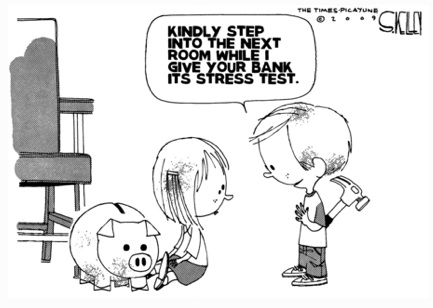


Repaying TARP Funds: Playing Ball With Uncle Sam
Posted by Larry Doyle on April 20th, 2009 10:27 AM |
Last evening on NQR’s Sense on Cents with LD (note: you can listen to audio recording of the show from the BlogTalkRadio player in the right sidebar), I proposed that the Obama administration would not release individual results of the Bank Stress Tests. I further added that I thought the administration may encourage stronger banking institutions to channel funds to weaker institutions. In so doing, these stronger banks – such as JP Morgan and Goldman Sachs – may actually take equity stakes in the weaker banks. Will JP Morgan and Goldman bear the entire risk of those equity stakes? Doubtful. Uncle Sam will likely negotiate terms along the lines of other bank bailouts in which a strong bank provides capital but the government bears the brunt of the losses.
As I write this, Bloomberg reports Bank of America is speculated to need another $10-20 billion in equity capital. BofA’s earnings were reported this morning at .44 earnings per share versus an expectation of approximately .03 earnings per share. Analysts are panning the earnings due to the propsects for ongoing increases in credit losses within BofA’s loan portfolio. BofA’s stock is down approximately 8% in early trading.
If BofA does need another $10-$20 billion in equity capital, where might it come from? In my opinion, in a non-public transferral of capital, those funds may come from JP Morgan and/or Goldman Sachs, and would actually be recycled TARP funds. Effectively, JPM and GS will merely be a conduit for increased government funds injected into BofA and Citigroup, as well. Remember JPM has $25 billion in TARP funds, Goldman has $10 billion. If BofA took $15 billion of these funds then Citi could receive $20 billion. What would JPM and GS receive in return? I would think these negotiations would be private and not released, although given that the capital provided is public money all information should be released. Read the rest »
Comments (2)