Subscribe: RSS Feed | Twitter | Facebook | Email
Home | Contact Us

Scoundrel Hedge Funds? Don’t Just Stop There

Posted by Larry Doyle on May 11th, 2009 6:40 AM |

Hedge funds are bad guys, right? Greedy, unethical, opaque, right? Well, hedge funds are largely opaque and that needs to be addressed in order to make sure that trading and investment activity occurs in an ethical fashion. That said, hedge funds are like any other industry; there are some bad seeds mixed in with plenty of outstanding individuals. Do the bad seeds warrant an industrywide assault? I don’t think so, but that is what we are seeing from the Obama administration on the heels of the Chrysler bankruptcy.

I see the issues in the hedge fund as follows:

1.  This industry should be required to pay taxes on income generated at ordinary income tax rates instead of as carried interest and thus at long term capital gains rates. The Obama administration has looked to implement this change in their budget. This move is long overdue. 

2.  The industry should be regulated and/or regularly monitored. Why regular oversight did not occur after Long Term Capital Management imploded in 1998 is beyond the life of me. Who may monitor them? A division within the SEC. (for those interested in the topic of hedge funds and Wall Street oversight, a must read is When Genius Failed: The Rise and Fall of Long Term Capital Management by Roger Lowenstein)

The collapse of LTCM in 1998, a mere 5 years after its founding, exposed many of the problems within the hedge fund industry. Although the principals in LTCM were not bailed out, the process of unwinding that firm was viewed as a Fed orchestrated takeover. Many moral hazards were violated. Many shoddy business practices were exposed. Very few real regulatory changes were implemented. There is no doubt in my mind that the manner in which LTCM was handled set the precedent for many of the problems of the last few years. (I wrote extensively about this topic in my March 18th piece: “AIG and LTCM“)

 It has always been widely speculated that many Wall Street firms profited handsomely from the LTCM debacle. How so? Representatives from each firm were involved in a committee that took over the LTCM operations. In the process, firms became aware of the vulnerability of market sectors in which LTCM had significant exposure. Traders at firms drove markets in one direction or another to further LTCM’s pain. There is no doubt we have experienced similar scenarios recently. Goldman Sachs, rightly or wrongly, is typically the firm implicated for this activity.      

3.  Hedge funds are the most active traders in the marketplace. A large number of traders within hedge funds came from Wall Street banks and maintain close relationships at the banks. Additionally, hedge funds also have close relationships amongst themselves.  Dare I say, without aggressive oversight, the system allows and effectively engenders coordinated if not collusive trading activity. This is not a new development. 

4.  Often traders from hedge funds transact business directly with traders at Wall Street banks without a salesman involved to act as an intermediary. This type of business is a compliance violation.  Hedge funds want access to information from traders rather than salespeople who filter it or do not fully understand it. 

5.  I am very suspect that there are still a number of unexposed Ponzi schemes disguised as hedge funds. The fact that so many funds suspended redemptions is a sign the “flow of oxygen” to continue the scam had stopped. In fact, I would strongly suspect that a number of hedge funds farmed money to Bernie Madoff knowing full well the nature of Bernie’s business.

Are all these points an indictment of the entire industry? NO! As with any industry, there are plenty of unsavory and unethical charlatans. I could write a similar scathing review of illicit activities in banking, insurance, asset management, technology, politics (that would be a long one), and regulatory bodies.

The simple fact is hedge funds, in general, and the unsavory firms in particular, pushed the envelope because they were allowed. In fact, given the massive amounts of contributions which Washington politicians effectively commanded from them, it is not a stretch to propose that hedge funds were buying their own cover and protection.

In so many words, though, haven’t the large banks been operated as massive hedge funds as well? The banks utilized massive leverage, off balance sheet vehicles, active trading, and proprietary models to run their businesses. The banks also contributed massively to Washington coffers. Additionally, the banks funded their own regulatory oversight in the name of FINRA.

If banks operated as hedge funds, did the SRO (self-regulatroy oversight) FINRA also operate as a hedge fund? No, FINRA merely invested hundreds of millions of their OWN dollars in hedge funds and fund of funds. FINRA should be compelled to release the names of those funds. The circle is complete.

If Obama wants to castigate the hedge fund industry (WSJ reports Hedge Funds Are Piqued by White House) as being scoundrels and attempt to curry political favor with his constituencies in the process, he is morally bankrupt if he does not also address the complicit nature of the banks, politicians, and regulators as well. 

LD


Happy Mother’s Day!!!

Posted by Larry Doyle on May 10th, 2009 8:00 AM |

Happy Mother’s Day to all the Moms who put the love into the relationships which make living worthwhile.

To those Moms in my life: from the mother of my children, my Mom, and my Mother-in-law, how did I ever get so lucky?

May today be filled with love and happiness for Moms everywhere . . . and then tomorrow we’re back to TARP, TALF, and Stress Tests . . . oh what fun!!

Enjoy!!

LD


NQR’s Sense on Cents with Larry Doyle Tonight at 8PM

Posted by Larry Doyle on May 10th, 2009 7:05 AM |

UPDATE: The show has concluded, but you can listen to a recording of it in its entirety by clicking the Play button on the audio player below. Once the playback has started, you can fast forward or rewind to any portion of the show by clicking at any point along the play bar.

************************************

Please join me Sunday evening from 8-9 p.m. ET for NoQuarter Radio’s Sense on Cents with Larry Doyle. The developments in the markets, economy, global finance, Wall Street, and Washington are occurring at breakneck speed. I will try to slow things down a bit and provide a sense of perspective. What did we learn in the markets over the last week and what does that mean for the weeks and months ahead? We will address a wide range of issues.

Tonight my guest will be Rick Johnson, author of Keep Your Assets. Take My Advice. Rick’s book focuses on providing sound advice to help protect investors from being victims of Wall Street’s shenanigans. After listening to tonight’s show, you will be “armed to the teeth . . . with the information you need to easily navigate through the perilous traps set by inexperienced and unscrupulous financial advisors” (from Rick Johnson’s website).

These are truly historic times in the global economy. Let’s “navigate the economic landscape” without the pandering or nonsense found elsewhere! What is on your mind? What would you like to address? Please share your questions and thoughts by calling in to (347) 677-0792, and also join our live chat room, which I’ll start up about 10 minutes before the show begins.

Many thanks to Larry Johnson and the rest of the team at NoQuarterUSA blog for providing such a vibrant vehicle as NoQuarter Radio. I look forward to having you join me Sunday evening as we collectively navigate the economic landscape!!

LD


The Big Lie

Posted by Larry Doyle on May 9th, 2009 1:00 PM |

These viewpoints are not widely disseminated by the mainstream media. The numbers don’t lie, however, and the level of defaults already being experienced on prime mortgages falls into the range (3-4%) of what Treasury designated as “worst case.”

Karl Denninger, at Market Ticker, writes a detailed, must-read sobering piece: Why We Are Absolutely Screwed

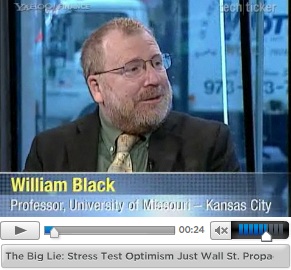
In addition, William Black – a former bank regulator – opines the lack of rigor in the bank stress tests. The 5-minute video clip, The Big Lie: Stress Test Optimism Just Wall St. Propaganda, is enlightening.

william-black-on-techticker


Saturday Morning News Roundup

Posted by Larry Doyle on May 9th, 2009 5:42 AM |

Articles I have read over the last 24 hours and strongly recommend:

Wall Street Journal: Banks Won Concessions On Tests

The Washington Post: Fannie Loses $23 Billion, Prompting Even Bigger Bailout

Wall Street Journal: Hit By Mortgage Defaults, Fannie Needs $19 Billion

Telegraph: China Fears Bond Crisis As It Slams Quantitative Easing  (h/t to MC)

Los Angeles Times: California Could Be Broke By July, State Official Warns

LD


Simon Johnson and Goldilocks

Posted by Larry Doyle on May 8th, 2009 3:56 PM |

Shortly after writing my “Goldilocks Economy” post, I caught an interview that Simon Johnson gave to Carol Massar (no, she is not Goldilocks!!) of BloombergTV. Johnson is formerly the chief economist of the IMF, and currently a Professor at MIT’s Sloan School of Management and a senior fellow at the Peterson Institute for International Economics. 

In this 7 minute clip, Johnson covers virtually all the questions I raised in my “Goldilocks” post, including:

1. ongoing financial support of the banking industry

2. the Wall Street-Washington dynamic

3. government guarantees allowing the banking sector to “print” profits

4. the rigor and results of the Bank Stress Tests

5. expectations for inflation and potentially hyperinflation

6. Johnson calls Goldman Sachs a “branch of the government”

7. compares our economy to an emerging market…not too dissimilar

8. can banks earn their way out of this mess? or will it be Japan in the 1990s all over again?

9. implications of an inverted yield curve on bank profits…HINT: it’s not good!!

10. prospects for massive budget deficits with rising taxes

11. need for regulation

Check out 7 minutes of must watch video from Bloomberg, brought to you by Sense on Cents!! (FYI . . . the interview with Simon Johnson starts about 30 seconds into the video clip).

Enjoy!!

LD


Goldilocks Economy

Posted by Larry Doyle on May 8th, 2009 1:15 PM |

Will the wizards in Washington be able to recreate the Goldilocks economy, in which we can generate moderate growth with limited inflation and near full employment? Well, that economic dream is still off in the distance, but the Goldilocks analogy is appropriate. How’s that? Much like the cherished tale, the wizards are faced with three choices in virtually every situation: too much, too little, just right.

Fiscal policy
 – too much spending and/or improperly targeted spending will drive interest rates higher via massive deficits and potential hyperinflation.

 – too little spending and/or improperly targeted will not properly stimulate the economy and may lead to a bout of deflation.

 – just the right amount of spending and properly targeted will support the economy and stabilize prices.

Monetary Policy
 – too much gas on this fire will massively grow the money supply and lead to hyperinflation.

 – not enough gas or a slow delivery (the concern in Europe) will not stop the economy from sliding into a deeper recession.

 – just right will lead to support for the economy. However, our wizards must be prescient and know exactly when to turn the gas line down and then off. If this procedure is not executed with precision, our house may go up in the flames of hyperinflation. Many wise and elderly wizards, including none other than Paul Volcker, have this concern.

Regulatory  
 – overly restrictive regulations will inhibit an entrepreneurial spirit and drive business overseas.

 – ineffective, inappropriate, or insufficient regulations will lead to further moral hazards and an economic foundation akin to a pile of sand. Dare I say, our house is suffering from this problem currently.

 – just right would compel new regulators with real teeth to redraft the rules by which we play. Paul Krugman wrote “Stressing The Positive” in yesterday’s New York Time and addressed this topic. Krugman offers:

. . . what worries me most about the way policy is going isn’t any of these things. It’s my sense that the prospects for fundamental financial reform are fading.

Does anyone remember the case of H. Rodgin Cohen, a prominent New York lawyer whom The Times has described as a “Wall Street éminence grise”? He briefly made the news in March when he reportedly withdrew his name after being considered a top pick for deputy Treasury secretary.

Well, earlier this week, Mr. Cohen told an audience that the future of Wall Street won’t be very different from its recent past, declaring, “I am far from convinced there was something inherently wrong with the system.” Hey, that little thing about causing the worst global slump since the Great Depression? Never mind.

Those are frightening words. They suggest that while the Federal Reserve and the Obama administration continue to insist that they’re committed to tighter financial regulation and greater oversight, Wall Street insiders are taking the mildness of bank policy so far as a sign that they’ll soon be able to go back to playing the same games as before.

Uncle Sam’s intervention
 – too much involvement means private enterprise will either not play in our markets or charge a higher price in the form of higher interest rates (this is VERY likely to happen given the disregard for property rights and the validity of contracts).

 – too little and the economy may take another leg down in the form of a triple dip.

 – just right . . . how do we compel Uncle Sam to be a benevolent Old Man and not encroach on the principles of capitalism, free markets, and private enterprise as he tries to push forward with a massive social agenda and enormous spending plans?

The trail on which we are proceeding will be LONG. Will we be able to find that warm home in the woods? Do we have the fortitude and courage to sacrifice as need be or do we have leaders who are blinded by ambition and agendas which will cause us to lose our way?

Bring extra supplies.   

LD


May Unemployment Report:
UPDATED as of 9:00AM >>

Posted by Larry Doyle on May 8th, 2009 7:17 AM |

Before this morning’s numbers were released, I published:

The widely anticipated May Unemployment Report covering the month of April is due out this morning at 8:30am (EST).  Will this report show signs of improving trends in the pace of layoffs? Aside from the actual report, we need to pay strict attention to the revisions for prior months to assess the overall health of “our patient.” In regard to revisions and the actual report, a month ago I had written in my post April Unemployment Report: 

Analysts hit the numbers, as they came in as expected. Wow! Are the analysts that good or are these numbers being “managed” or “massaged” so as not to overly upset the markets?  Well, we did have a significant revision to January’s report. Let’s dig deeper!!    

Call me paranoid, but when a January Non-Farm Payroll number is revised from a loss of 655k jobs to 741k and no revision is provided for February, I immediately ask why. 

Previous month’s data and expectations for the May report are as follows:
**Note: I have now included the actual unemployment statistics (which were released at 8:30AM), along with my post-report commentary:

Unemployment Rate
      March: 8.1%
      April: 8.5%
      Expectation for May: 8.9%  (recall how this rate was the base case used for Bank Stress Tests…and here we are hitting it in May!!)
      
Actual for May: 8.9%

Post-report comment: as expected . . . however, the Underemployment Rate is now 15.8%. This rate consists of those unemployed and looking for work, unemployed and have given up looking, and part-time workers who would prefer full-time. To that end, I wonder how many temporary workers in the Census Bureau would prefer full-time work. 

Non-Farm Payroll (click here for definition of this term)
       March: loss of 651k
      April : loss of 663k
      Expectation for May: loss of 600k 
      Actual May report: loss of 539k
      Revisions: February and March combined lost another 66k jobs

Post-report comment: on the face, the report appears better than expected but given the additional job losses in the revised numbers for February (an additional 18k jobs) and March (an additional 48k jobs) we are still in the 600k average job loss for the month. Private sector lost 611k jobs while government added 72k jobs with a lot of those people being temporary workers employed by the Census Bureau. The fact that temporary government workers are factored into overall employment, in my opinion, is stretching the integrity of the report. Health care added 17k jobs, manufacturing lost 149k jobs, construction lost 110k jobs, financial services lost 40k jobs. 

As I referenced above, I will be looking for a February revision as well.

Average Hourly Earnings
      March: +.2
      April : +.2
      Expectation for May: +.2
      
Actual May report: +.1 

Post-report comment: businesses are doing everything to manage costs. This number is lower than expected and will not help consumer spending and retail sales going forward. With no wage pressures, this component of inflation will remain in check 

Average Hourly Workweek 
      March : 33.3 hours
      April: 33.2 hours
      Expectation for May: 33.2 hours 
    
 Actual May report: 33.2 hours

Post-report comment: as expected…

Please check back shortly after 8:30am to review the numbers and market reaction!! In pre-market trading, stock futures indicate the market would open higher by approximately 1%. The 10yr U.S. Treasury is quoted at 3.35%.

Post-report comment: the bond market has rallied marginally as the overall report continues to show weakness throughout the private sector. The equity market is a touch lower. Analysts are spinning the report as a slowing in the pace of declines. Does this report portend an improved tone in spending, economic activity, and lessened defaults and foreclosures? Not in a hurry.

If you like what you read and see here, please put Sense on Cents in your favorites, and visit and comment often!! Thanks!!  

LD 


Navigating the “Murky Waters” of Financial Services

Posted by Larry Doyle on May 7th, 2009 7:57 PM |

I am thrilled to have Rick Johnson as my guest on NoQuarter Radio’s Sense on Cents with Larry Doyle this Sunday evening May 10th. As Forbes recently reported:

JACKSONVILLE, Fla., May 1 /PRNewswire/ — Rick Johnson, author of the book Keep Your Assets. Take My Advice, applauds the Financial Planning Coalition’s effort to establish an oversight board to regulate financial advisers. The Financial Planning Coalition, according to a recent update emailed to Certified Financial Planners, is proposing an oversight board with fiduciary standards, training and ethics requirements for financial planning advice that favors consumers. FINRA is trying to influence the Securities and Exchange Commission in order to regulate registered investment advisers, as stated in a recent speech by Richard G. Ketchum, Chairman and CEO of FINRA, before the Committee on Banking, Housing and Urban Affairs. The Financial Planning Coalition “wants to preclude FINRA from consideration as the oversight body … ” as stated in their April 27, 2009 email update. “This is a battle between lobbying groups with consumers caught in the crossfire,” according to Johnson.

In an April 27th FINRA News Release, FINRA has proposed closing a glaring gap in their Broker Check system that previously allowed advisers with revoked licenses to have their backgrounds dropped from the FINRA Broker Check system after two years. In his book, Keep Your Assets Take My Advice, Johnson pointed out this exact problem.

The suggestion from Johnson’s book is to close the background check loopholes. As quoted, “We need one disciplinary disclosure system for all insurance agents, FINRA-registered representatives and investment adviser representatives of registered investment advisers.”

In his book, Johnson breaks down why the fiduciary standard of care is what all consumers should demand. “You cannot do what is in the best interest of the consumer and have a sales quota. It is impossible. As long as these sales quotas remain, there is no chance at a fiduciary standard of care,” says Johnson.

Johnson educates his readers about the fiduciary standard of care, how to do annual background checks on financial advisers and he provides unique financial planning ideas typically not found in recently published financial advice books. Readers of his book will be “armed to the teeth,” according to Johnson, to navigate the “murky waters” of financial services.

Who is looking out for you? Sense on Cents and Rick Johnson this Sunday evening on NoQuarter Radio.

LD


Uncle Sam’s Regulatory Double Standard

Posted by Larry Doyle on May 7th, 2009 5:24 PM |

As I have referenced previously, Jonathan Weil of Bloomberg truly distinguishes himself as the finest commentator within the world of financial journalism. Weil takes on the financial regulatory authorities for their selective enforcements. Today he reports, Lehman Bosses Walk, While Small Fry Walk Plank. Why after 2 years haven’t senior executives from mortgage origination firms (Countrywide, Ameriquest, New Century, Long Beach), quasi-government agencies (Freddie and Fannie), commercial and investment banks, and credit rating agencies been more thoroughly investigated, if not arrested and prosecuted?

Is there any doubt these firms and executives effectively purchased their own protection? After writing “How Wall Street Bought Washington,” it became exceedingly clear that money from Wall Street bought protection for the business units and the individuals. It is not likely that Uncle Sam will target executives at firms holding government money. Additionally, if Uncle Sam targets execs at failed firms, those execs would be likely to finger others.

As Uncle Sam is now both investor and regulator in the markets, how do market participants compel him to be an honest broker on both fronts? As Weil writes, quoting former SEC head Chris Cox:

“From the standpoint of the SEC, the most obvious problem with breaking down the arm’s-length relationship between government, as the regulator, and business, as the regulated, is that it threatens to undermine our enforcement and regulatory regime,” Cox said in a Dec. 4 speech.

“When the government becomes both referee and player, the game changes rather dramatically for every other participant. Rules that might be rigorously applied to private-sector competitors will not necessarily be applied in the same way to the sovereign who makes the rules.”

Haven’t we already seen this play? Why is it that public confidence in the markets and those overseeing them is so low? When the security patrol in the casino also has LOTS of chips on the table, how do we know the dealer isn’t also in on the action? If so, is it any wonder why the unsavory activities of other “boys in the club” who have run out of chips aren’t being prosecuted?

I commend Weil for raising this topic. I can only hope other media outlets will pressure the regulators to level the playing field.

LD


« Newer Posts — Older Posts »


Recent Posts


ECONOMIC ALL-STARS


Archives