 RSS Feed
 Twitter
 Facebook
 Email
Email Home
HomeI Need That Money More Than You Do
Posted by Larry Doyle on April 19th, 2009 9:15 PM |
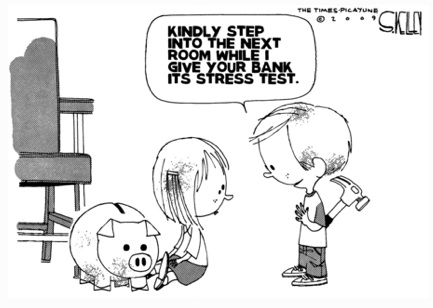
Cartoon by Steve Kelley, The Times-Picayune
Audio Recording of NQR’s Sense on Cents with Larry Doyle for April 19, 2009
Posted by Larry Doyle on April 19th, 2009 9:09 PM |
In case you missed LD’s Sunday night radio show, just click on the Play button below for the audio recording. Once the playback has started, you can fast forward or rewind to any portion of the show by clicking at any point along the play bar.
Larry’s special guest was Chris Lowney, author of Heroic Leadership: Best Practices from a 450-Year-Old Company that Changed the World

Bank Stress Tests: Threading the Needle
Posted by Larry Doyle on April 19th, 2009 12:44 PM |
For those involved in assessing the solvency of our domestic banking system, the prospects of releasing the results of the Bank Stress Tests are frightening. How do Secretary Geithner, Fed chair Bernanke, regulators, and President Obama himself maintain credibility with the markets while simultaneously growing confidence in the public?
As Bloomberg reports, Bank Regulators Clash Over U.S. Stress-Tests Endgame. Secretary Geithner clearly was trying to buy time when he proposed the Bank Stress Test model. The day of reckoning will soon be upon us. The administration will release the model used on April 24 and the results on May 4th. However, there are enormous conflicts within the administration and the regulatory community as to how to release the information and how much information to release.
As Bloomberg highlights,
The U.S. Treasury and financial regulators are clashing with each other over how to disclose results from the stress tests of 19 U.S. banks, with some officials concerned at potential damage to weaker institutions.
With a May 4 deadline approaching, there is no set plan for how much information to release, how to categorize the results or who should make the announcements, people familiar with the matter said. While the Office of the Comptroller of the Currency and other regulators want few details about the assessments to be publicized, the Treasury is pushing for broader disclosure.
The disarray highlights what threatens to be a lose-lose situation for Treasury Secretary Timothy Geithner: If all the banks pass, the tests’ credibility will be questioned, and if some banks get failing grades and are forced to accept more government capital and oversight, they may be punished by investors and customers.
“There are plenty of ways to go wrong here,” said Wayne Abernathy, executive vice president of the American Bankers Association in Washington. “It might have sounded good at the time, but now looking back, it has far more risk than benefit.”
What will come of this? The pressure from all corners is increasing on Geithner. Can he snatch victory from what may appear to be a lose-lose situation? Can he somehow or other get the results forestalled and maintain credibility? Can he keep the various constituencies placated? Truly, he needs to “thread the needle.”
Listen to NQR’s Sense on Cents with Larry Doyle this evening from 8-9 p.m. as I discuss how I think Secretary Geithner will try to thread the needle.
LD
Tune in Sunday Evening to NoQuarter Radio’s Sense on Cents with Larry Doyle
Posted by Larry Doyle on April 19th, 2009 7:34 AM |
Please join me Sunday evening from 8-9 p.m. ET for NoQuarter Radio’s Sense on Cents with Larry Doyle.  The developments in the markets, economy, global finance, Wall Street, and Washington are occurring at breakneck speed. I will try to slow things down a bit and provide a sense of perspective. What did we learn in the markets over the last week and what does that mean for the weeks and months ahead? We will address a wide range of issues, including: transparency and quality of earnings, Goldman’s and JP Morgan’s initiative to pay back TARP, and upcoming bank stress test results.
 In addition, my guest Sunday night will be Chris Lowney. Lowney, formerly a Jesuit, was named a Managing Director of J.P. Morgan while still in his thirties and held senior positions in New York, Tokyo, Singapore and London until leaving the firm in 2001. He served successively on Morgan’s Asia-Pacific, Europe, and Investment Banking Management Committees. Lowney’s first book, Heroic Leadership: Best Practices from a 450-Year-Old Company that Changed the World, was the #1 ranked bestseller of the CBPA (Catholic Book Publishers Association) and was named a finalist for a 2003 Book of the Year Award from ForeWord magazine. It has been translated into ten languages. (more…)
Don’t Try This at Home
Posted by Larry Doyle on April 18th, 2009 5:08 PM |
Have you ever watched a stuntman spin a sports car in a sharp 180 degree maneuver? Many stunts come with the advance warning: Don’t Try This at Home.
Not that the current actions of both the U.S. Treasury and Federal Reserve are stunts, but their maneuvers also come with a serious warning signal . . . and it reads: INFLATION!!
Given the doubling in size of the Fed’s balance sheet, if and when the economy catches, the multiplier effect on our domestic money supply will be akin to throwing lighter fluid and a match on a field full of hay. That inferno can create a scenario worse than our current economic predicament.
The WSJ reports:
“The key to preventing inflation will be reversing the programs, reducing reserves, and raising interest rates in a timely fashion,” he (Fed Vice Chairman Donald Kohn) said.
Reversing the programs? With all due respect, if people think the Fed or anybody else is uniquely qualified to drain trillions in liquidity from our markets in a precise manner prior to inflation running rampant, then they are sadly mistaken. Please remember that one of the biggest factors in determining the rate of inflation is the mere expectation of inflation itself. In so many words, our economy may start to experience inflation prior to changes in certain fundamentals in the economy.
While the WSJ reports, Fed’s No. 2 Allays Worries About Stimulus, please remember that any medication that is overused, if not unintentionally abused, can be very dangerous if not fatal. We need look no further than the use of CDS (credit default swaps). CDS used properly provide a valid means of hedging risk. Similarly, increasing the money supply via an increase in the use of the Fed’s balance sheet and assorted Treasury programs can be an appropriate medication.
However, have you ever heard a patient indicate an exact point in time when they knew they were using medication inappropriately, if not in an abusive fashion? Have you ever witnessed a patient who has misused medication to be able to turn his life around on a dime?
I appreciate Mr. Kohn’s confidence in the Fed’s abilities, but neither he nor the Fed have experience in dealing with a situation like this.
Don’t think for a second that the cure can’t be worse than the disease.
LD
Wall Street Buys Albany
Posted by Larry Doyle on April 18th, 2009 1:00 PM |
The “pay to play” game in which municipal, state, or federal officials solicit or accept kickbacks in turn for directing government business is regrettably deeply embedded into our political and financial industries. As much as authorities and regulators talk about cleaning it up, without aggressive deterrents in place to truly punish parties on both ends of a transaction, these corrupt activities will continue.
As we follow the money once again, we see that it leads to a firm named Quadrangle, recently headed by Steven Rattner, the current car czar. Associates at Quadrangle have been implicated in providing kickbacks to individuals who manage the allocation of funds from the New York State pension.
This scenario has all the sordid details of a B-rated movie or a tawdry teenage novel. While the characters involved may be cheap in terms of character and integrity, the cost borne by taxpayers and society is very dear. If one allocation of funds from the pension is polluted by kickbacks, it would be naive to think that many dollars emanating from the New York State pension is not similarly polluted.
Why is it that President Obama selected Steven Rattner for the high profile position of car czar? To be perfectly honest, I would imagine that Secretary Geithner and Larry Summers selected Rattner. Geithner and Summers know how to play the Wall Street game and have benefitted from it. (more…)
Citigroup’s Earnings: More Fuzzy Math
Posted by Larry Doyle on April 18th, 2009 9:21 AM |
In reviewing bank earnings this week, I truly get the sense with a number of institutions that they determine just how much they want or need to outperform analyst expectations and then they figure out how to “manage” the books in order to get there.
This “managed earnings” process can be played for an extended period, but ultimately the earnings – or more importantly “hidden losses” – come out in the wash.
Citigroup played this game yesterday. The NY Times reports, After Year of Losses, Citigroup Finds a Profit. I give the Times credit; they did not report that Citigroup generated a profit, but that they found it. Where did they find it? The Times offers:
Like several other banks that reported surprisingly strong results this week, Citigroup used some creative accounting, all of it legal, to bolster its bottom line at a pivotal moment.
Citi utilized creative accounting supported by the pressure applied by Congress on the FASB. Where is the pressure applied by the SEC and FINRA on behalf of investors? Isn’t it only fair that somebody speaks up for investors? Is the SEC and FINRA in bed with Congress to “play the game?” Let’s move on.
The top rated banking analyst on the street chimes in: (more…)

Who’s Minding the Store?
Posted by Larry Doyle on April 17th, 2009 10:48 AM |
Despite the fact that the Auction Rate Securities market totally froze in February 2008, Citigroup is accused of fraudulently marketing and selling the product even in August 2008. Bloomberg reports, Citigroup Accused of Selling Disguised Auction Bonds.
Just as you never find only one mouse or roach, to think this is the only incident of Citigroup selling disguised Auction Rate Securities would be amazingly naive. If Citigroup were engaged in this fraud in August 2008, I would also bet that other banks were doing it as well.
Regrettably, people in desperate straits do desperate things. Similarly, firms desperately in need of cash will also do desperate things. How many other investors purchased disguised bonds? Or, I should say, were sold disguised bonds?
How is it that a situation like this occurs? Internal cops, compliance and sales management, are asleep at the wheel. External cops, our friends at FINRA, are also asleep at the wheel. Who headed FINRA at that point? Our current SEC head, Mary Schapiro. (more…)
“White House Ties to Wall Street Doom Bank Rescue”
Posted by Larry Doyle on April 17th, 2009 6:37 AM |
None other than Nobel Prize winner Joseph Stiglitz of Columbia University provided a direct shot across Washington’s and Wall Street’s bow today. As I read Bloomberg’s Stiglitz Says White House Ties to Wall Street Doom Bank Rescue, the little voice in my head kept repeating, ” he’s right” or “I agree.” I am reluctant to copy and paste entire articles, but this one is so important that I feel compelled and will add commentary or links as warranted.
The Obama administration’s plan to fix the U.S. banking system is destined to fail because the programs have been designed to help Wall Street rather than create a viable financial system, Nobel Prize-winning economist Joseph Stiglitz said.
“All the ingredients they have so far are weak, and there are several missing ingredients,” Stiglitz said in an interview. The people who designed the plans are “either in the pocket of the banks or they’re incompetent.”
The Troubled Asset Relief Program, or TARP, isn’t large enough to recapitalize the banking system, and the administration hasn’t been direct in addressing that shortfall, he said. Stiglitz said there are conflicts of interest at the White House because some of Obama’s advisers have close ties to Wall Street.
Seems as if Stiglitz would agree with How Wall Street Bought Washington.
“We don’t have enough money, they don’t want to go back to Congress, and they don’t want to do it in an open way and they don’t want to get control” of the banks, a set of constraints that will guarantee failure, Stiglitz said.
The return to taxpayers from the TARP is as low as 25 cents on the dollar, he said. “The bank restructuring has been an absolute mess.” (more…)


